


Religious Education
Key Stage Four Curriculum
Name of Course: AQA GCSE Religious Studies 8062A
Head of Department: Mrs S. Taylor
Exam board website: AQA | Religious Studies | GCSE | GCSE Religious Studies
Specification
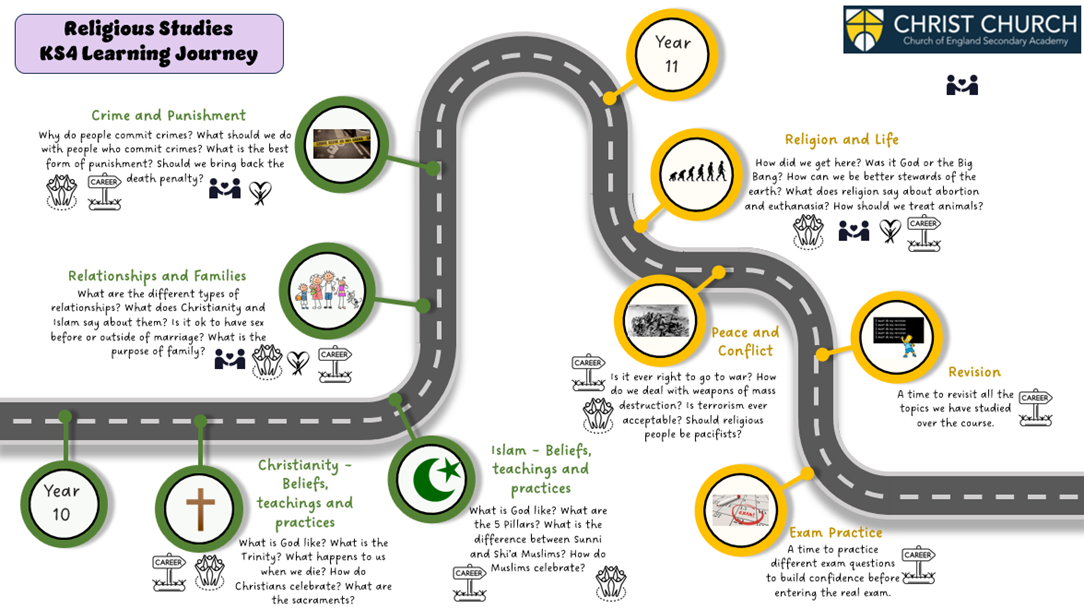
This course follows the AQA GCSE Religious Studies A specification, which provides a systematic and a thematic approach to studying Religious Studies. Topics include relationships and family dynamics, crime and how society deals with criminal behaviour, medical/ethical issues such as abortion, euthanasia and animal rights. It also examines the rights and wrongs of modern warfare.
Course content:
The AQA GCSE Religious Studies course is divided into two main sections. Students must take assessments in the following two components:
- Component 1: The study of religions: beliefs, teachings and practices: Christianity & Islam
- Component 2: Thematic studies:
Theme A: Relationships and families.
Theme B: Religion and life.
Theme D: Religion, peace and conflict.
Theme E: Religion, crime and punishment.
Assessment details:
The course is assessed through two exams:
Component 1: The study of religions: beliefs, teachings and practices
- Written exam: 1 hour 45 minutes
- 96 marks, plus 3 marks for spelling, punctuation and grammar (SPaG)
- 50% of GCSE
Each religion has a common structure of two five-part questions of 1, 1, 4, 6 and 12 marks.
Each religion is marked out of 48
Component 2: Thematic studies:
- Written exam: 1 hour 45 minutes
- 96 marks, plus 3 marks for spelling, punctuation and grammar (SPaG)
- 50% of GCSE
Each theme has a common structure of one five-part question of 1, 1, 4, 6 and 12 marks.
Each theme is marked out of 24.
Why study this course?
Religious Studies GCSE covers a range of the major world religions, contemporary ethical themes ensuring a diverse choice of intriguing subjects to explore. Students will be challenged with questions about belief, values, meaning, purpose and truth, enabling them to develop their own attitudes towards religious issues.
Students will also gain an appreciation of how religion, philosophy and ethics form the basis of our culture. They will also develop analytical and critical thinking skills, the ability to work with abstract ideas, leadership and research skills. All these skills will help prepare them for further study.
Revision Guide Recommended
We recommend the following revision guides to support your studies:
CGP: AQA A GCSE (9–1) Religious Studies -Christianity & Islam
CGP: AQA A GCSE (9–1) Religious Studies -Christianity & Islam Revision Question Cards
Oxford Revise: AQA A GCSE Religious Studies – Christianity & Islam
- These guides provide clear explanations, practice questions, and tips to help students prepare for their exams.
Future Careers
Studying Religious Studies opens up a wide range of career opportunities. Religious Studies graduates are in demand for their skills of analysis, evaluation, understanding and empathy, amongst others. Potential careers include:
- Police
- Law
- Teaching
- Social Work/Care work
- Armed Forces
- Medicine
- Charity Sector
Religious Studies can also lead to careers in fields like journalism/T.V., PR/advertising, Government/politics thanks to the transferable skills it offers.
Name of Subject: Religious Education
Key Stage Three Curriculum
The principal aim of Religion Education is to engage pupils in systematic enquiry into significant human questions which religions and worldviews address, so that they can develop the understanding and skills needed to appreciate and appraise varied responses to these questions, as well as develop responses of their own.
Christianity, as well as all of the other major faiths, speak of how we should treat one another, how best to live a good life and generally how to behave like a good citizen. The British values that form a large part of the education system are largely based around Christian values and are also found in other faiths and belief systems around the world and within a diverse, multi-cultural, multi-faith Britain. The other principal aim of Religion Education is to develop students, by engaging them in a meaningful enquiry into human questions and nurture them as caring, thoughtful, responsible citizens who have a spiritual awareness about the world and how that awareness can influence their own lives and the lives of others.
Religious Education examines many different topic areas that fall into one of three ‘lenses’: Theology, Philosophy and Social Science/Ethics in order for them to gain a broad overview and understanding of life, beliefs and people around, which will then help them in the wider world where they will meet others from all faiths, cultures and social backgrounds.
Year 7
Curriculum intention and building on prior learning
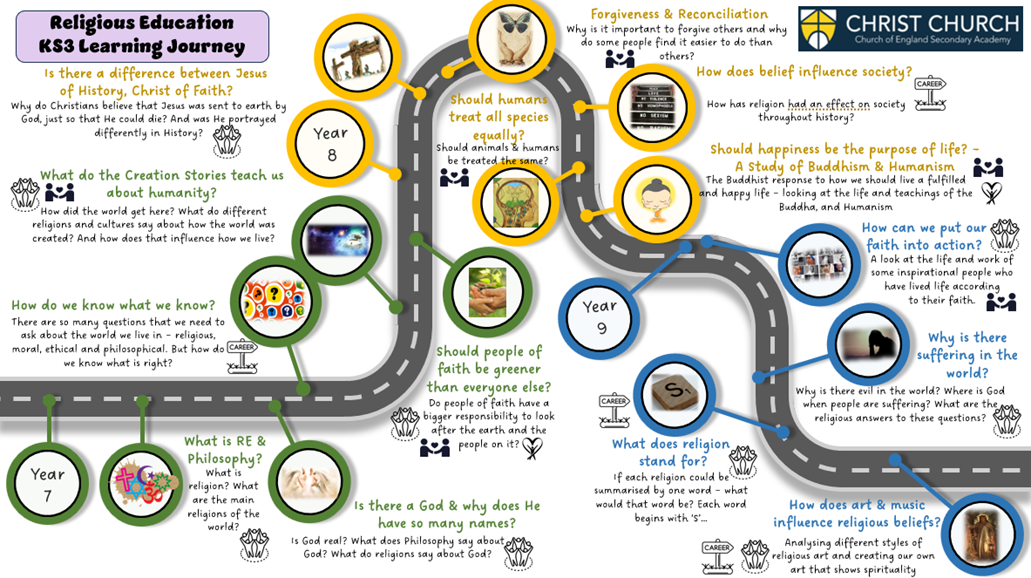
The Year 7 Religious Education curriculum builds on students’ prior learning and experiences by stretching their thinking abilities and allowing them the opportunity to use the factual information that they learnt at primary school and apply it by evaluating how people behave according to their beliefs.
What will students study in Year 7?
| Term | Content | Assessment Topics for revision |
| Term 1 | Theology/Philosophy Intro to Religion Does God exist and why does He have so many names? | Key terminology – theist, atheist, agnostic. The Design Theory. Christian and Hindu names and roles for God. Evaluating whether God is real |
| Term 2 | Philosophy How do we know what we know? | Key terminology – moral, religious, fundamental, utilitarianism. Religious, moral and fundamental questions. The life of Socrates and Plato. The ideas and beliefs of Jeremy Bentham. |
| Term 3 | Theology What do the creation stories teach us about humanity? Social Science Should people of faith be greener than everyone else? |
How is your child assessed?
Religious Education assesses students on 5 strands:


Pushing for Progress
• Consider how the issues and beliefs in Religious Education are linked to how people behave.
• Improve evaluative writing by developing chains of reasoning and being able to write from a different point of view to their own.
• Reflect on their work regularly, setting personal improvement goals.
How might you help at home?
- Consider how the issues and beliefs in Religious Education are linked to how people behave.
- Improve evaluative writing by developing chains of reasoning and being able to write from a different point of view to their own.
- Reflect on their work regularly, setting personal improvement goals.
Homework
Students will be expected to complete tasks at home such as assessment preparation i.e. revising key information, practicing extended writing, completing classwork, extended their learning/understanding of the classwork, or researching certain topics.
All homework is set on Class Charts and resources to assist the work is on Teams.
Year 8
Curriculum intention and building on prior learning
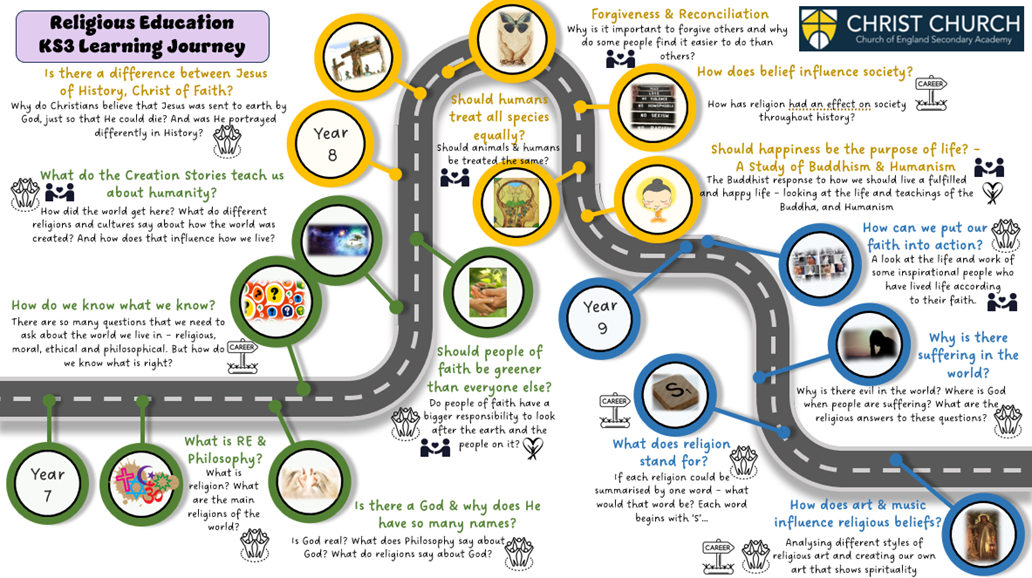
The Year 8 Religious Education curriculum builds on students’ prior learning from Year 7 by using their skills of understanding on how we can ask and answer questions, by helping them apply that to understanding behaviours of people. They also begin to connect a person’s belief with their actions.
What will students study in Year 8?
| Term | Content | Assessment Topics for revision |
| Term 1 | Theology Is there a difference between Jesus of History, Christ of Faith? Social Science/ Theology Forgiveness & Reconciliation | Key terminology – creation, obey, punishment, saviour, Messiah. What happened at the crucifixion of Jesus? Why was Jesus crucified? |
| Term 2 | Social Science How does belief influence society? | Key terminology – freedom fighter, miracle, assimilation, integration, segregation, agape, imago dei. How was Jesus like a freedom fighter? Were the miracles of Jeus real? What did Martin Luther King believe about segregation and why? |
| Term 3 | Philosophy Should humans treat all species equally? Theology/ Philosophy Should happiness be the purpose of life? |
How is your child assessed?
Religious Education assesses students on 5 strands:


Pushing for Progress
• Consider how the issues and beliefs in Religious Education are linked to how people behave.
• Improve evaluative writing by developing chains of reasoning and being able to write from a different point of view to their own.
• Reflect on their work regularly, setting personal improvement goals.
How might you help at home?
- Consider how the issues and beliefs in Religious Education are linked to how people behave.
- Improve evaluative writing by developing chains of reasoning and being able to write from a different point of view to their own.
- Reflect on their work regularly, setting personal improvement goals.
Homework
Students will be expected to complete tasks at home such as assessment preparation i.e. revising key information, practicing extended writing, completing classwork, extended their learning/understanding of the classwork, or researching certain topics.
All homework is set on Class Charts and resources to assist the work is on Teams.
Year 9
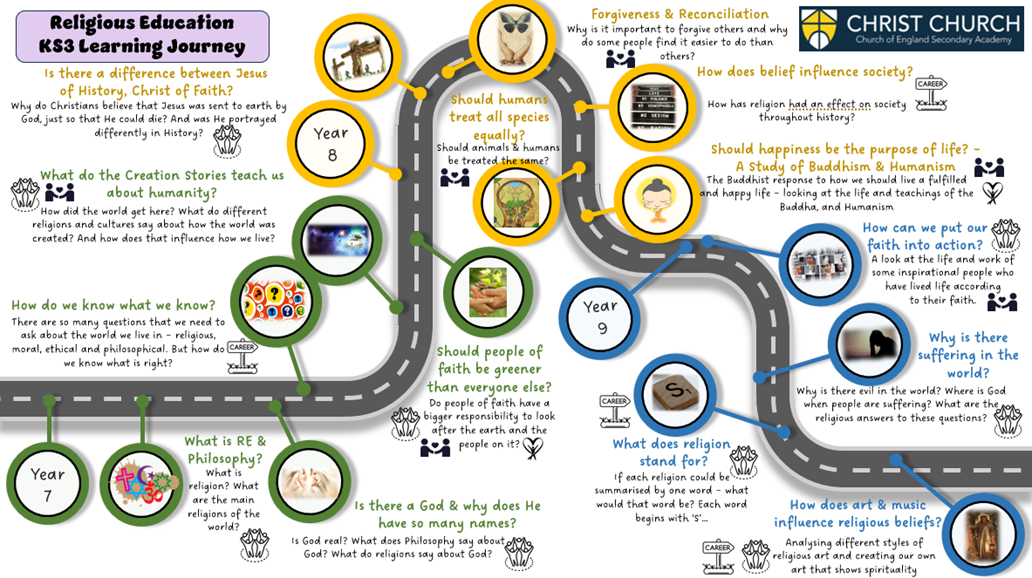
The Year 9 Religious Education curriculum builds on students’ prior learning and experiences by asking them to analyse, discuss and evaluate some of the big fundamental questions and issues that affect the world today.
What will students study in Year 9?
| Term | Content | Assessment Topics for revision |
| Term 1 | Social Science How can we put our faith into action? | Key terminology – ahimsa, devotion, apartheid, dignity, The tough guidance of Jesus. The life and work of Mother Teresa. The beliefs and actions of Mahatma Gandhi. The stories of Guru Nanak. |
| Term 2 | Philosophy Why is there Suffering in the world? | Key terminology – natural, human-made, omnipotent, omnibenevolent, omniscient, punishment, karma, justice, faith, nirvana. How can there be a God when there is so much suffering in the world. The Christian, Jewish, Hindu, Muslim and Buddhist responses to suffering. |
| Term 3 | Theology What does religion stand for? Social Science How does art & music influence religious beliefs? |
How is your child assessed?
Religious Education assesses students on 5 strands:


Pushing for Progress
• Consider how the issues and beliefs in Religious Education are linked to how people behave.
• Improve evaluative writing by developing chains of reasoning and being able to write from a different point of view to their own.
• Reflect on their work regularly, setting personal improvement goals.
How might you help at home?
- Consider how the issues and beliefs in Religious Education are linked to how people behave.
- Improve evaluative writing by developing chains of reasoning and being able to write from a different point of view to their own.
- Reflect on their work regularly, setting personal improvement goals.
Homework
Students will be expected to complete tasks at home such as assessment preparation i.e. revising key information, practicing extended writing, completing classwork, extended their learning/understanding of the classwork, or researching certain topics.
All homework is set on Class Charts and resources to assist the work is on Teams.