


Physical Education
Name of Course: OCR Sports Science
Head of Department: Daniel Wells
Exam board website: OCR Cambridge National.
Key Stage Three Curriculum
Physical Education offer a Spiral Curriculum. Meaning pupils will revisit sports each year, with the skills and learning progressively increasing in difficulty and depth of knowledge.
Year 7
Curriculum intention and building on prior learning
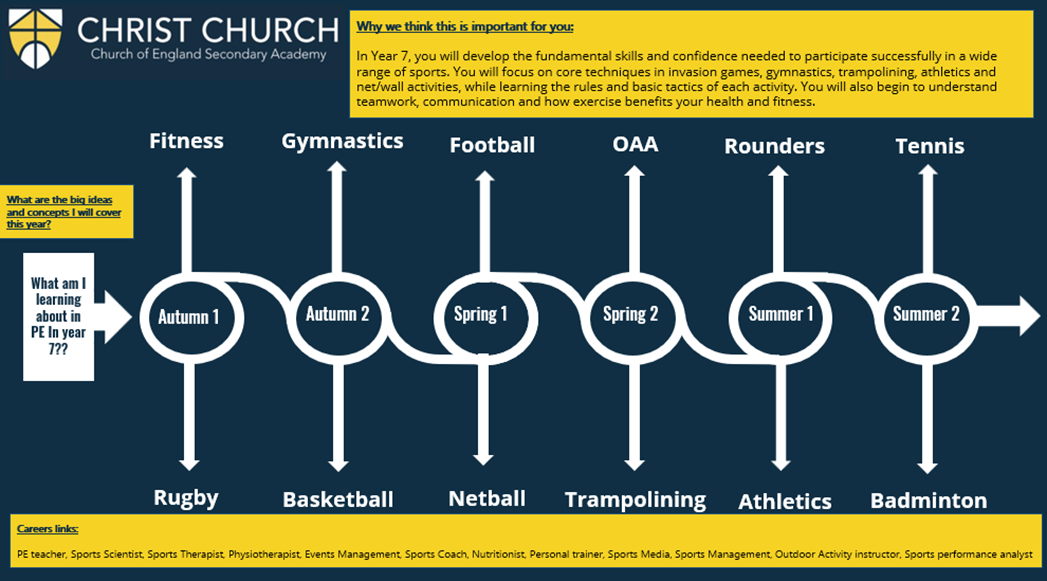
What will students study in Year 7?
Year 7: Focus: Developing fundamental skills, confidence and understanding of rules
| Activity | Key Skills Developed | Knowledge & Understanding |
| Rugby | Safe tackling, backward passing, evasion, defensive positioning | Basic rules, attacking space, teamwork |
| Football | Controlled dribbling, short passing, shooting, 1v1 defending | Positions, simple formations, transition play |
| Netball | Passing techniques, pivoting, shooting, marking | Footwork rule, positional roles |
| Basketball | Dribbling both hands, lay-ups, defensive stance | Basic attacking/defensive principles |
| Rounders | Basic batting, overarm bowling, catching, fielding | Scoring system, simple tactics |
| Badminton | Grip, underarm serve, forehand clear, rallying | Court layout, scoring, recovery position |
| Gymnastics | Rolls, balances, cartwheels, linking sequences | Body tension, control, fluency |
| Trampolining | Straight/tuck/pike/straddle jumps, seat landing | Safety routines, body control |
| Athletics | Sprint technique, relay baton exchange, Pacing, basic throws | Pacing, introduction to technique |
| Fitness | Circuit training, agility drills, flexibility work | Components of fitness, warm-up principles |
| OAA | Team challenges, basic orienteering, communication tasks | Leadership basics, problem-solving strategies |
How is your child assessed?
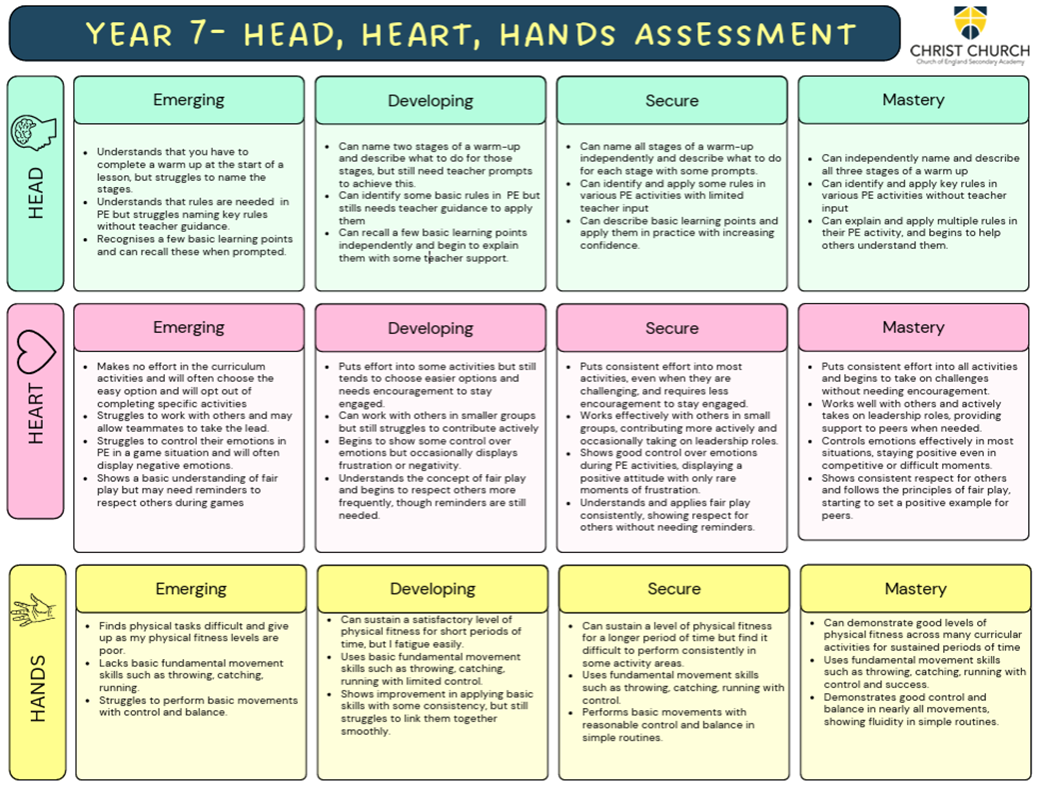
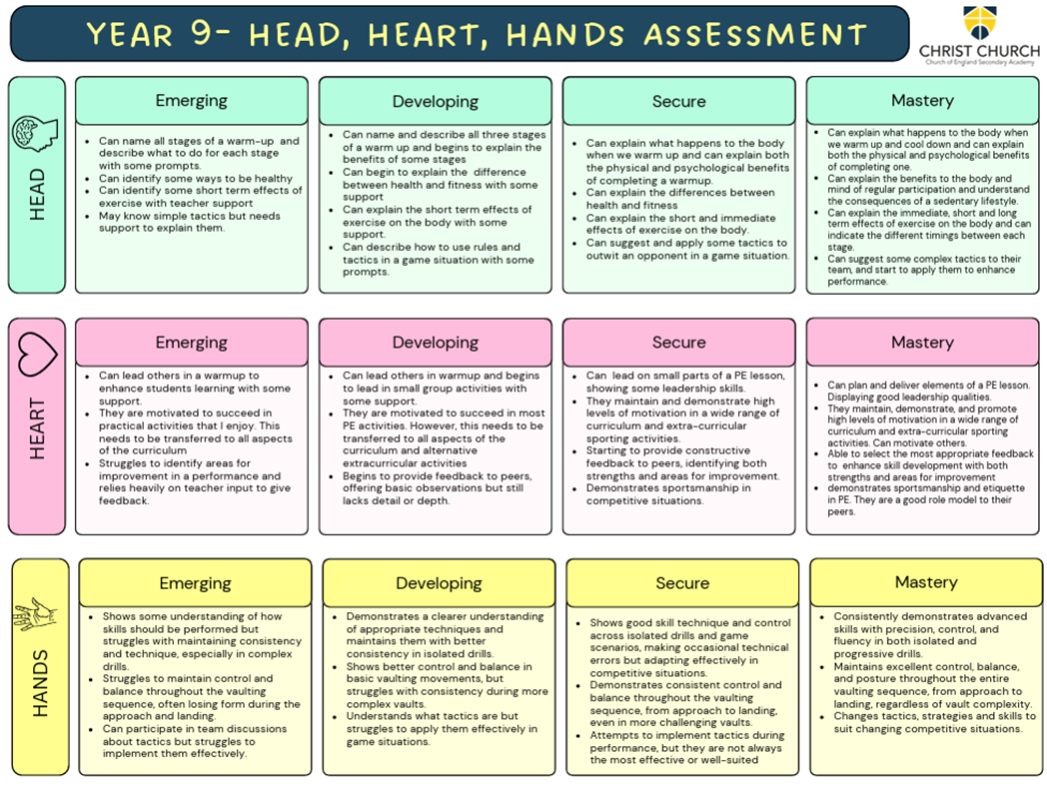
Pupils are assessed at the end of each sport using our Head, Heart, Hands assessment model. Hands measures their practical application of skills and overall performance within activities. Head assesses their knowledge and understanding of techniques, rules and tactics. Heart focuses on attitude, effort, resilience and willingness to engage positively in lessons. In addition to practical assessments, pupils will complete a formal written assessment point during the year, where they demonstrate their understanding of the skills, tactics and key concepts they have learned across activities.
Pushing for Progress
How might you help at home?
Parents can support PE at home by encouraging regular physical activity, whether that’s going for a walk, visiting the gym, playing recreational sport or reducing sedentary screen time. Showing interest in what pupils are learning in PE — such as discussing tactics, rules or fitness methods — helps reinforce understanding. Encouraging participation in school clubs or local sports teams can also build confidence and resilience. Ensuring pupils attend lessons with the correct kit and a positive attitude makes a significant difference to their progress and enjoyment in PE.
Homework
Homework is given to pupils at the end of each topic. This is set on Class Charts and summarises the skills learnt in lessons.
Year 8
Curriculum intention and building on prior learning
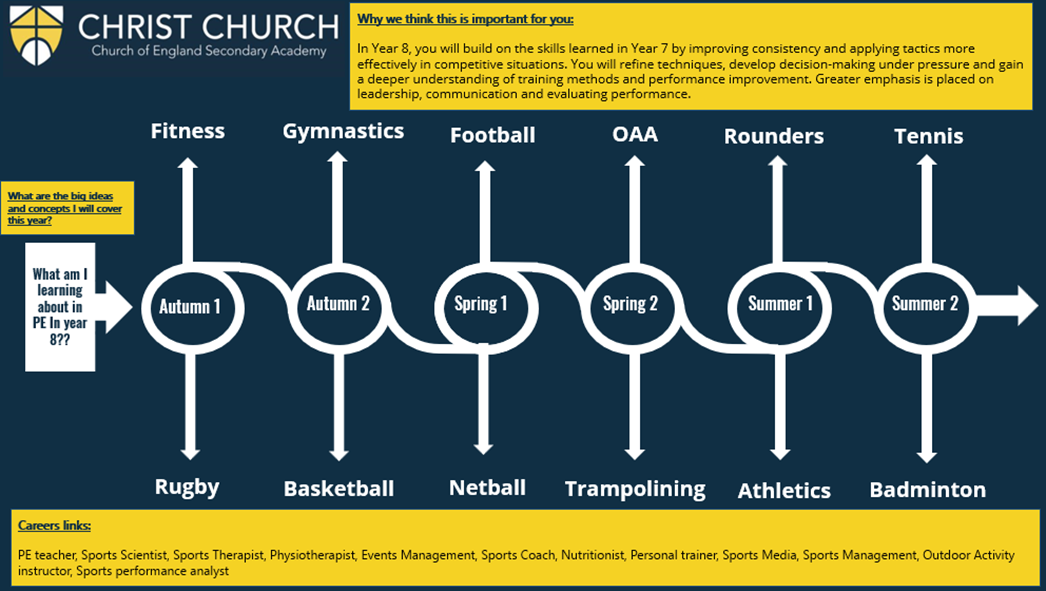
What will students study in Year 8?
Year 8: Focus: Improving consistency, applying tactics, developing decision-making
| Activity | Key Skills Developed | Knowledge & Understanding |
| Rugby | Ruck basics, defensive line speed, creating overlaps | Structured play, decision-making under pressure |
| Football | Combination play, finishing under pressure, pressing | Tactical shape, set pieces |
| Netball | Attacking patterns, interceptions, shooting under pressure | Centre pass routines, communication strategies |
| Basketball | Fast breaks, zone defence introduction, rebounding | Offensive/defensive systems |
| Rounders | Tactical batting placement, backstop strategy, field positioning | Game strategy and teamwork |
| Badminton | Overhead clear, drop shot, smash introduction | Shot selection, court coverage |
| Tennis | Serve technique, groundstrokes, volley introduction | Singles positioning, scoring consistency |
| Gymnastics | Flight elements, group choreography, canon/unison | Judging criteria, composition principles |
| Trampolining | Front/back landings, linking 5–7 skill routines | Routine construction, controlled height |
| Athletics | Middle-distance pacing, improved jumps and throws | Performance analysis basics |
| Fitness | Introduction to HIIT, resistance exercises | Training methods and their effects |
How is your child assessed?
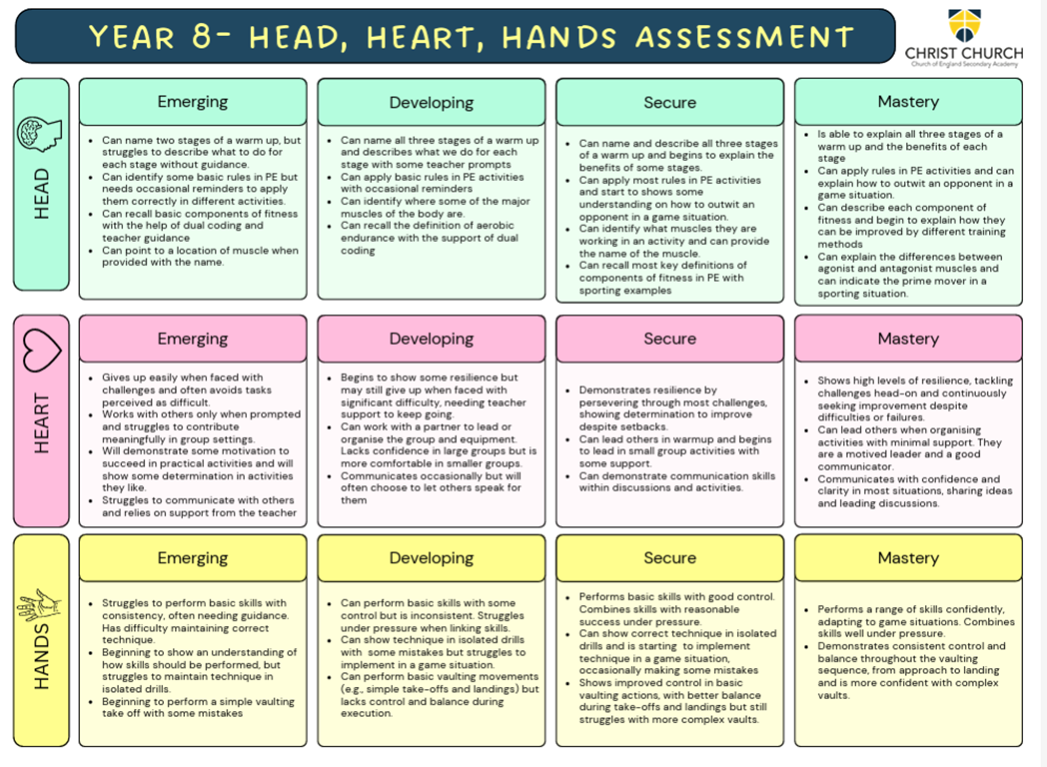
Pupils are assessed at the end of each sport using our Head, Heart, Hands assessment model. Hands measures their practical application of skills and overall performance within activities. Head assesses their knowledge and understanding of techniques, rules and tactics. Heart focuses on attitude, effort, resilience and willingness to engage positively in lessons. In addition to practical assessments, pupils will complete a formal written assessment point during the year, where they demonstrate their understanding of the skills, tactics and key concepts they have learned across activities.
Pushing for Progress
How might you help at home?
Parents can support PE at home by encouraging regular physical activity, whether that’s going for a walk, visiting the gym, playing recreational sport or reducing sedentary screen time. Showing interest in what pupils are learning in PE — such as discussing tactics, rules or fitness methods — helps reinforce understanding. Encouraging participation in school clubs or local sports teams can also build confidence and resilience. Ensuring pupils attend lessons with the correct kit and a positive attitude makes a significant difference to their progress and enjoyment in PE.
Homework
Homework is given to pupils at the end of each topic. This is set on Class Charts and summarises the skills learnt in lessons.
Year 9
Curriculum intention and building on prior learning
What will students study in Year 9?
Year 9: Focus: Advanced tactics, independence and leadership
| Activity | Key Skills Developed | Knowledge & Understanding |
| Rugby | Structured attacking patterns, game management | Tactical analysis, leadership in play |
| Football | Formations, exploiting space, advanced finishing | Game analysis, officiating roles |
| Netball | Zone defence, advanced attacking strategies | Tactical substitutions, leadership |
| Basketball | Complex offensive plays, defensive switching | Tempo control, refereeing |
| Rounders | Advanced batting technique, strategic field placement | Game management and captaincy |
| Badminton | Tactical shot variation, doubles positioning | Match strategy, independent officiating |
| Tennis | Spin serves, doubles tactics, match play | Strategy adaptation during competition |
| Gymnastics | Independent routine composition, advanced transitions | Evaluation using performance criteria |
| Trampolining | Extended linked routines, difficulty progression | Competition standards, self-analysis |
| Athletics | Personal performance targets, technical refinement | Data-informed performance improvement. |
| Fitness | Fitness Testing and training programmes | Principles of training, injury prevention |
| OAA | Independent navigation, team leadership | Reflection, problem-solving under pressure |
How is your child assessed?
Pupils are assessed at the end of each sport using our Head, Heart, Hands assessment model. Hands measures their practical application of skills and overall performance within activities. Head assesses their knowledge and understanding of techniques, rules and tactics. Heart focuses on attitude, effort, resilience and willingness to engage positively in lessons. In addition to practical assessments, pupils will complete a formal written assessment point during the year, where they demonstrate their understanding of the skills, tactics and key concepts they have learned across activities.
Pushing for Progress
How might you help at home?
Parents can support PE at home by encouraging regular physical activity, whether that’s going for a walk, visiting the gym, playing recreational sport or reducing sedentary screen time. Showing interest in what pupils are learning in PE — such as discussing tactics, rules or fitness methods — helps reinforce understanding. Encouraging participation in school clubs or local sports teams can also build confidence and resilience. Ensuring pupils attend lessons with the correct kit and a positive attitude makes a significant difference to their progress and enjoyment in PE.
Homework
Homework is given to pupils at the end of each topic. This is set on Class Charts and summarises the skills learnt in lessons.
Course content
- For this qualification, students must achieve three units: one externally assessed and two Non Examined Assessment (NEA) units.
Unit R180 – Reducing the risk of sports injuries and dealing with common medical conditions.
- This unit is our EXAM unit that the pupils will take at the end of year 11. This is 70 marks total and is worth 40% of your overall grade.
R181 – Applying the principles of training: fitness and how it affects skill performance
- This unit is a coursework-based unit. Pupils will complete 5 assignments with 80 marks total and is worth 40% of your overall grade.
R183 – Nutrition and sports performance
- This unit is a coursework-based unit. Pupils will complete 4 assignments with 40 marks total and is worth 20% of your overall grade.
Assessment details
All results are awarded on the following scale:
| Sports Science Grade | GCSE Grade Equivalent | Minimum Total Marks (out of 200) |
| Level 2 Distinction* | Grade 8.5 | 180 |
| Level 2 Distinction | Grade 7 | 160 |
| Level 2 Merit | Grade 5.5 | 140 |
| Level 2 Pass | Grade 4 | 120 |
| Level 1 Distinction | Grade 3 | 100 |
| Level 1 Merit | Grade 2 | 80 |
| Level 1 Pass | Grade 1.25 to 1.75 | 60 |
Why study this course?
OCR Sports Science is a theory-based qualification that gives students a detailed understanding of how the body works in relation to sport and physical activity, with no practical performance assessment. The course is made up of three units. The examined unit, worth 40% of the final grade, focuses on reducing the risk of sports injuries and dealing with common medical conditions. Students learn about different types of injuries (such as sprains, strains, fractures and dislocations), how injuries occur, and how they can be prevented through safe practice, warm-ups, cool-downs and protective equipment. They also study basic treatment methods, including first aid principles, as well as medical conditions such as asthma, diabetes and epilepsy, and how these can impact participation in sport.
The two remaining units are assessed through coursework. In the Applying the Principles of Training unit (40%), students explore the components of fitness, methods and principles of training (including SPORT and FITT), goal setting, and how different types of fitness affect skill performance. They learn how to plan, justify and evaluate training programmes for individuals. In the Nutrition and Sports Performance unit (20%), students study the role and function of nutrients, energy use, hydration, and how to plan appropriate diets to support different sporting activities and performance goals. Overall, the course provides a strong scientific and theoretical understanding of sport, health and performance, assessed through a combination of examination and structured written assignments.