


Mathematics
Name of Course: Mathematics
Head of Department: U. Dodhia
Exam board website: Pearson Edexcel
Key Stage Three Curriculum
At Christ Church Secondary Academy, Mathematics is taught through an adapted version of the Sparx Maths mastery curriculum, fully aligned to the National Curriculum. Our approach is rooted in the belief that all students can succeed in mathematics with the right support, challenge and sequencing.
Across Key Stage Three, students develop:
- Fluency in core mathematical skills
- Reasoning through explanation and justification
- Problem-solving through structured and varied practice
Learning is carefully sequenced in small, connected steps that build on prior knowledge and prepare students for future study. We use multiple representations, intelligent practice and variation theory to deepen conceptual understanding.
We are committed to fostering a positive mathematical culture where students are curious, confident and resilient. Mathematics is presented not only as an academic subject but as a powerful tool for understanding the world and preparing for life in modern Britain.
Key Stage Four Curriculum
Course content
At Key Stage Four, students follow the GCSE Mathematics specification. The curriculum builds on KS3 foundations and prepares students for both GCSE examinations and life beyond school.
Students study content across the three main strands:
- Number (including percentages, ratio, proportion, indices and standard form)
- Algebra (including equations, graphs, sequences and formulae)
- Geometry & Measures (including trigonometry, constructions, surface area and volume)
- Statistics & Probability (including handling data, tree diagrams and statistical representations)
Problem-solving is embedded throughout the curriculum. Students are explicitly taught how to:
- Break down multi-step problems
- Reflect on their thinking
- Adapt strategies when needed
- Apply mathematics to real-world contexts
Structured revision, daily retrieval practice, spaced learning and challenging problem sets ensure students are well prepared for examination success.
Assessment details
Assessment in Mathematics is designed to check understanding over time and secure long-term retention.
Short-Term (In Lesson):
- Frequent use of mini whiteboards
- Live marking and verbal feedback
- Plenary to assess core learning
Medium-Term (Unit Tests):
- Low-stakes topic tests 1–2 weeks after teaching
- Whole-class feedback sheets used to address misconceptions
Long-Term (Summative Assessments):
- Termly assessments including interleaved topics
- Calculator and non-calculator papers
- Marked using GCSE-style mark schemes
Why study this course?
Mathematics is essential for success in education, employment and everyday life. Studying Mathematics helps students to:
- Develop logical thinking and reasoning skills
- Build resilience and perseverance
- Interpret data and make informed decisions
- Manage money and understand financial concepts
- Access a wide range of careers including engineering, finance, medicine, architecture, computing and business
We aim to develop students who appreciate the beauty, power and relevance of mathematics and who are equipped to contribute positively to modern society.
Year 7
Curriculum intention and building on prior learning
Year 7 builds on primary learning in number, calculation and basic geometry. The focus is on strengthening foundational skills and developing mathematical confidence through mastery-based teaching.
Students deepen understanding of:
- Place value and number operations
- Fractions, decimals and percentages
- Basic algebraic thinking
- Geometry and measures
- Introduction to statistics and probability
Learning is carefully sequenced to close gaps and extend thinking.
Image: Learning Journey
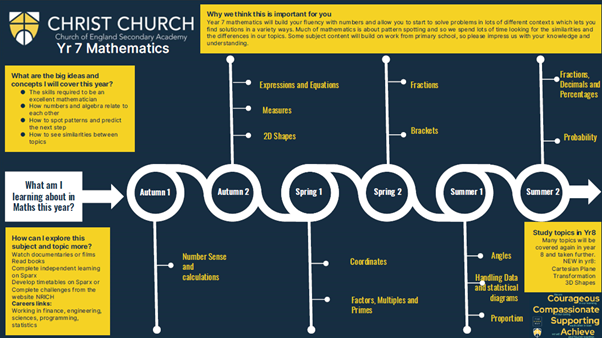
What will students study in Year 7?
| Term | Content | Assessment Topics for revision |
| Term 1 | 1. Place value (integers & decimals) and number lines 2. Ordering, rounding and negative numbers 3. Four operations with integers & decimals 4. Multiplication & division methods (including decimals & remainders) 5. Powers, roots & order of operations 6. Introduction to algebra (notation, simplifying, substitution, solving one-step equations) | M763, M704, M522, M527, M111, M431, M928, M429, M347, M152, M113, M911, M187, M803, M462, M354, M873, M262, M491, M106, M288, M135, M521, M952, M409, M813, M830, M795, M531, M949, M417, M327, M208, M979, M707 |
| Term 2 | 1. Units & time (conversions, timetables, calendars) 2. Measures (length, mass, capacity) 3. Geometry: lines, shapes & symmetry 4. Perimeter & area (rectangles, compound shapes, triangles) 5. Coordinates 6. Factors, multiples & primes (HCF, LCM, prime factor decomposition) | M515, M892, M627, M963, M747, M828, M774, M487, M814, M276, M523, M920, M635, M690, M900, M390, M269, M610, M996, M618, M230, M227, M823, M698, M322, M108 |
| Term 3 | 1. Fractions (equivalence, simplifying, ordering, operations) 2. Algebra: expanding & factorising 3. Angles (types, measuring, angle rules) 4. Statistics (averages & range) 5. Charts & data representation 6. Proportion, percentages & probability | M158, M939, M410, M671, M335, M601, M835, M931, M637, M237, M792, M100, M502, M541, M780, M331, M818, M163, M351, M328, M934, M841, M940, M899, M597, M644, M460, M738, M945, M127, M440, M478, M216, M157, M110, M197, M265, M695, M684, M958, M264, M553, M235, M655, M941, M938, M755, M718 |
How is your child assessed?
Explanation followed by end points document
Students are assessed through:
- Do Now retrieval activities
- Exit tickets
- Unit assessments
- Termly summative assessments
Feedback is provided through live marking, whole-class feedback sheets and structured student response in green pen.
Pushing for Progress
We support progress through:
- Daily retrieval practice
- Spaced revision
- Challenging problem-solving tasks
- Structured talk to develop mathematical reasoning
- Targeted intervention and support
- Homework drop-in at lunch
How might you help at home?
- Encourage regular completion of Sparx Maths homework
- Ask your child to explain their reasoning aloud
- Support revision using Sparx codes
- Encourage resilience when questions feel challenging
- Promote independent learning habits
Homework
Homework is set weekly on Sparx maths. We have chosen Sparx maths as it offers spaced retrieval, with adaptive, desirable difficulty baked in.
Christ Church Secondary Academy – Sparx Maths
Students are expected to complete their weekly maths home learning using the online platform Sparx Maths.
Sparx Maths is a personalised programme that sets, checks and tracks homework automatically. It adapts to each student’s level of understanding, ensuring the work is both achievable and appropriately challenging. This helps students grow in confidence and make steady progress in mathematics.
Our approach to home learning reflects our school values:
- Flourishing Futures – preparing students for success in school and beyond
- Collaboration – families and school working together to support learning
- Compassion – recognising that students progress at different rates
- Strength – building perseverance through regular practice
- Aspiration – encouraging students to aim high in their learning
How does Sparx Maths home learning work?
- Each week, Sparx creates a personalised set of questions based on your child’s current level of understanding, confidence and pace of learning.
- The questions are designed to be accessible while still providing appropriate challenge so students can make progress.
- Every question includes short help videos and guidance so students can get support when they are unsure.
- With the support available, students are expected to complete their homework accurately.
How can I support my child?
We know families want to help with maths homework. Please encourage your child to try each question independently first.
Independent practice allows Sparx to identify strengths and gaps so future homework remains correctly matched to your child’s needs.
If a question generates a purple “seek help” notification, students may then ask a parent, carer, older sibling or teacher for support.
Why is this homework important?
Regular, personalised practice helps students secure the key building blocks of mathematics. Sparx supports students to revisit, practise and strengthen their understanding so learning becomes secure and long‑lasting.
Consistent homework completion also builds positive study habits and resilience.
We recommend that students complete their homework early in the week, giving them time to ask for help from their teacher if needed before the deadline.
What support is available?
Support is available through:
- Maths teachers, who can provide guidance on challenging topics
- Help videos on the Sparx platform
- Catch‑up or support sessions run by the Maths Department
Rewards for consistent completion
We believe that effort and commitment should be recognised and celebrated. Students who complete their Sparx Maths homework consistently may receive:
- Praise and positive recognition from their Maths teacher
- Positive behaviour points for completing homework on time
- Certificates or acknowledgement in assemblies
- Opportunities for class‑based or year‑group rewards
- Recognition for high XP Points through Sparx challenges or school systems
These rewards help motivate students and celebrate the hard work they put into their learning.
Sanctions if homework is not completed
Sparx Maths is compulsory weekly homework for all students.
If homework is not completed:
- Students will be required to attend a catch‑up session during break, lunch or after school so they can complete the work with support.
- If homework is missed on multiple occasions, a detention will be issued in line with the school’s behaviour and homework policy.
- Parents and carers may be contacted if a student repeatedly does not engage with their home learning.
This approach ensures that students are supported to develop strong learning routines while also being held accountable for their effort.
What if my child finishes early?
Sparx also offers optional practice and challenge activities:
- XP Boost – revision questions from previously taught topics
- Target – extension questions to stretch students further
Students earn XP Points for all completed tasks, which contribute to class and school recognition systems and celebrate their commitment.
Year 8
Curriculum intention and building on prior learning
Image: Learning Journey
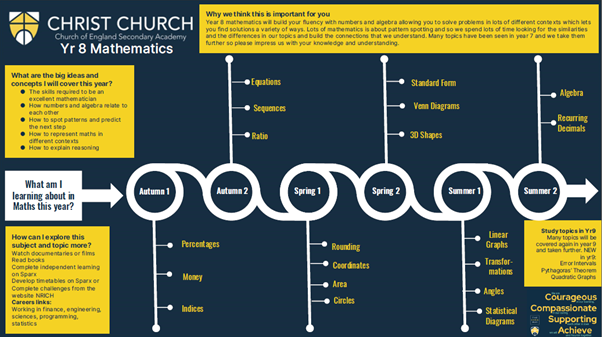
What will students study in Year 8?
| Term | Content | Assessment Topics for revision |
| Term 1 | 1. Percentages (of amounts & percentage change) 2. Ratio (simplifying, 1:n form, sharing, equivalent ratios) 3. Ratio, fractions & percentages conversions 4. Value for money problems 5. Indices (positive & negative powers, index laws) 6. Algebraic fractions & solving linear equations | M437, M905, M476, M533, M885, M543, M267, M801, M525, M681, M608, M150, M120, M568, M401, M902, M554, M387, M957 |
| Term 2 | 1. Sequences (term-to-term & position-to-term rules) 2. Scale diagrams 3. Significant figures & estimation 4. Coordinates & midpoints 5. Area (parallelograms, trapeziums) & area conversion 6. Circles & standard form | M381, M241, M166, M991, M866, M112, M994, M131, M878, M622, M311, M291, M705, M728, M595, M169, M231, M719, M678 |
| Term 3 | 1. Venn diagrams & probability 2. HCF & LCM (prime factor decomposition) 3. 3D shapes (nets, surface area, volume) 4. Graphs & transformations (straight line graphs, translation, reflection) 5. Angles (parallel lines, polygons, quadrilaterals) 6. Statistics & inequalities (charts, averages, inequalities, expanding brackets, algebraic fractions, recurring decimals) | M829, M419, M365, M767, M518, M884, M534, M661, M765, M722, M465, M797, M932, M544, M139, M290, M679, M319, M606, M393, M653, M574, M165, M140, M183, M648, M210, U854, M384, M118, M960, M645, M619, M754, M336, M701, M922 |
How is your child assessed?
Explanation followed by end points document
Students are assessed through:
- Do Now retrieval activities
- Exit tickets
- Unit assessments
- Termly summative assessments
Feedback is provided through live marking, whole-class feedback sheets and structured student response in green pen.
Pushing for Progress
We support progress through:
- Daily retrieval practice
- Spaced revision
- Challenging problem-solving tasks
- Structured talk to develop mathematical reasoning
- Targeted intervention and support
- Homework drop-in at lunch
How might you help at home?
- Encourage regular completion of Sparx Maths homework
- Ask your child to explain their reasoning aloud
- Support revision using Sparx codes
- Encourage resilience when questions feel challenging
- Promote independent learning habits
Homework
Homework is set weekly on Sparx maths. We have chosen Sparx maths as it offers spaced retrieval, with adaptive, desirable difficulty baked in.
Christ Church Secondary Academy – Sparx Maths
Students are expected to complete their weekly maths home learning using the online platform Sparx Maths.
Sparx Maths is a personalised programme that sets, checks and tracks homework automatically. It adapts to each student’s level of understanding, ensuring the work is both achievable and appropriately challenging. This helps students grow in confidence and make steady progress in mathematics.
Our approach to home learning reflects our school values:
- Flourishing Futures – preparing students for success in school and beyond
- Collaboration – families and school working together to support learning
- Compassion – recognising that students progress at different rates
- Strength – building perseverance through regular practice
- Aspiration – encouraging students to aim high in their learning
How does Sparx Maths home learning work?
- Each week, Sparx creates a personalised set of questions based on your child’s current level of understanding, confidence and pace of learning.
- The questions are designed to be accessible while still providing appropriate challenge so students can make progress.
- Every question includes short help videos and guidance so students can get support when they are unsure.
- With the support available, students are expected to complete their homework accurately.
How can I support my child?
We know families want to help with maths homework. Please encourage your child to try each question independently first.
Independent practice allows Sparx to identify strengths and gaps so future homework remains correctly matched to your child’s needs.
If a question generates a purple “seek help” notification, students may then ask a parent, carer, older sibling or teacher for support.
Why is this homework important?
Regular, personalised practice helps students secure the key building blocks of mathematics. Sparx supports students to revisit, practise and strengthen their understanding so learning becomes secure and long‑lasting.
Consistent homework completion also builds positive study habits and resilience.
We recommend that students complete their homework early in the week, giving them time to ask for help from their teacher if needed before the deadline.
What support is available?
Support is available through:
- Maths teachers, who can provide guidance on challenging topics
- Help videos on the Sparx platform
- Catch‑up or support sessions run by the Maths Department
Rewards for consistent completion
We believe that effort and commitment should be recognised and celebrated. Students who complete their Sparx Maths homework consistently may receive:
- Praise and positive recognition from their Maths teacher
- Positive behaviour points for completing homework on time
- Certificates or acknowledgement in assemblies
- Opportunities for class‑based or year‑group rewards
- Recognition for high XP Points through Sparx challenges or school systems
These rewards help motivate students and celebrate the hard work they put into their learning.
Sanctions if homework is not completed
Sparx Maths is compulsory weekly homework for all students.
If homework is not completed:
- Students will be required to attend a catch‑up session during break, lunch or after school so they can complete the work with support.
- If homework is missed on multiple occasions, a detention will be issued in line with the school’s behaviour and homework policy.
- Parents and carers may be contacted if a student repeatedly does not engage with their home learning.
This approach ensures that students are supported to develop strong learning routines while also being held accountable for their effort.
What if my child finishes early?
Sparx also offers optional practice and challenge activities:
- XP Boost – revision questions from previously taught topics
- Target – extension questions to stretch students further
Students earn XP Points for all completed tasks, which contribute to class and school recognition systems and celebrate their commitment.
Year 9
Curriculum intention and building on prior learning
Image: Learning Journey
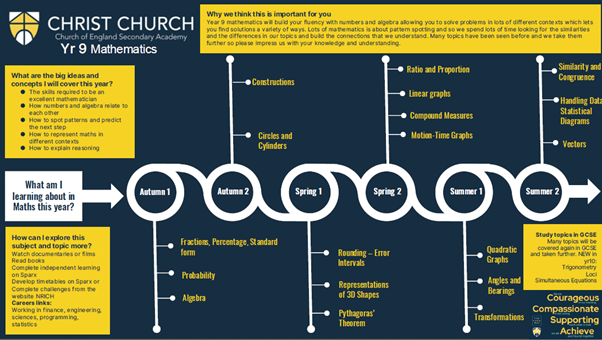
What will students study in Year 9?
| Term | Content | Assessment Topics for revision |
| Term 1 | 1. FDP and percentages (conversion, fractions, ordering, percentage increase/decrease, original value) 2. Simple interest & probability (experimental probabilities, expected results, frequency trees) 3. Standard form (add, subtract, multiply/divide, calculator use) 4. Inequalities (single, double, unknown on both sides) 5. Quadratic factorisation (x²+bx+c, difference of squares) 6. Changing the subject of formulae (1-step and multi-step) | U888, U594, U881, U916, U554, U349, U773, U671, U286, U278, U533, U166, U580, U280, U264, U290, U161, U738, U145, U337, U178, U963, U228, U675, U181 |
| Term 2 | 1. Circle and sector geometry (bisectors, perpendicular bisectors, sector lengths, arc length, area) 2. Surface area & volume (cylinders) 3. Measurement & error intervals (truncation, error bounds) 4. 2D & 3D geometry (plans, elevations, Pythagoras 2D/3D) 5. Ratio and proportion (simplifying, sharing, direct/inverse proportion, currency conversion) 6. Straight line graphs (plotting, equations, interpreting, speed/rate calculations) | U787, U245, U221, U373, U464, U915, U657, U108, U301, U743, U385, U828, U721, U357, U610, U741, U315, U669, U151, U256 |
| Term 3 | 1. Graphs (distance-time, quadratic, interpreting, solving graphically) 2. Angles (combined facts, parallel lines, quadrilaterals, polygons) 3. Bearings (measuring, calculating) 4. Transformations & similarity/congruence (translation, reflection, rotation, enlargement, mixed transformations, similar/congruent shapes, constructing triangles) 5. Statistics (data types, diagrams, averages, scatter plots, frequency tables, grouped data, lines of best fit) 6. Vectors (column vectors: addition/subtraction, scalar multiplication, identifying parallel vectors) | U403, U914, U462, U966, U989, U667, U601, U655, U826, U329, U427, U525, U107, U196, U799, U696, U519, M881, U551, U578, U790, U866, U187, U322, U571, U520, U717, U199, U277, U128, U312, U877, U840, U632, U903, U564, U660 |
How is your child assessed?
Explanation followed by end points document
Students are assessed through:
- Do Now retrieval activities
- Exit tickets
- Unit assessments
- Termly summative assessments
Feedback is provided through live marking, whole-class feedback sheets and structured student response in green pen.
Pushing for Progress
We support progress through:
- Daily retrieval practice
- Spaced revision
- Challenging problem-solving tasks
- Structured talk to develop mathematical reasoning
- Targeted intervention and support
- Homework drop-in at lunch
How might you help at home?
- Encourage regular completion of Sparx Maths homework
- Ask your child to explain their reasoning aloud
- Support revision using Sparx codes
- Encourage resilience when questions feel challenging
- Promote independent learning habits
Homework
Homework is set weekly on Sparx maths. We have chosen Sparx maths as it offers spaced retrieval, with adaptive, desirable difficulty baked in.
Christ Church Secondary Academy – Sparx Maths
Students are expected to complete their weekly maths home learning using the online platform Sparx Maths.
Sparx Maths is a personalised programme that sets, checks and tracks homework automatically. It adapts to each student’s level of understanding, ensuring the work is both achievable and appropriately challenging. This helps students grow in confidence and make steady progress in mathematics.
Our approach to home learning reflects our school values:
- Flourishing Futures – preparing students for success in school and beyond
- Collaboration – families and school working together to support learning
- Compassion – recognising that students progress at different rates
- Strength – building perseverance through regular practice
- Aspiration – encouraging students to aim high in their learning
How does Sparx Maths home learning work?
- Each week, Sparx creates a personalised set of questions based on your child’s current level of understanding, confidence and pace of learning.
- The questions are designed to be accessible while still providing appropriate challenge so students can make progress.
- Every question includes short help videos and guidance so students can get support when they are unsure.
- With the support available, students are expected to complete their homework accurately.
How can I support my child?
We know families want to help with maths homework. Please encourage your child to try each question independently first.
Independent practice allows Sparx to identify strengths and gaps so future homework remains correctly matched to your child’s needs.
If a question generates a purple “seek help” notification, students may then ask a parent, carer, older sibling or teacher for support.
Why is this homework important?
Regular, personalised practice helps students secure the key building blocks of mathematics. Sparx supports students to revisit, practise and strengthen their understanding so learning becomes secure and long‑lasting.
Consistent homework completion also builds positive study habits and resilience.
We recommend that students complete their homework early in the week, giving them time to ask for help from their teacher if needed before the deadline.
What support is available?
Support is available through:
- Maths teachers, who can provide guidance on challenging topics
- Help videos on the Sparx platform
- Catch‑up or support sessions run by the Maths Department
Rewards for consistent completion
We believe that effort and commitment should be recognised and celebrated. Students who complete their Sparx Maths homework consistently may receive:
- Praise and positive recognition from their Maths teacher
- Positive behaviour points for completing homework on time
- Certificates or acknowledgement in assemblies
- Opportunities for class‑based or year‑group rewards
- Recognition for high XP Points through Sparx challenges or school systems
These rewards help motivate students and celebrate the hard work they put into their learning.
Sanctions if homework is not completed
Sparx Maths is compulsory weekly homework for all students.
If homework is not completed:
- Students will be required to attend a catch‑up session during break, lunch or after school so they can complete the work with support.
- If homework is missed on multiple occasions, a detention will be issued in line with the school’s behaviour and homework policy.
- Parents and carers may be contacted if a student repeatedly does not engage with their home learning.
This approach ensures that students are supported to develop strong learning routines while also being held accountable for their effort.
What if my child finishes early?
Sparx also offers optional practice and challenge activities:
- XP Boost – revision questions from previously taught topics
- Target – extension questions to stretch students further
Students earn XP Points for all completed tasks, which contribute to class and school recognition systems and celebrate their commitment.
Year 10
Curriculum intention and building on prior learning
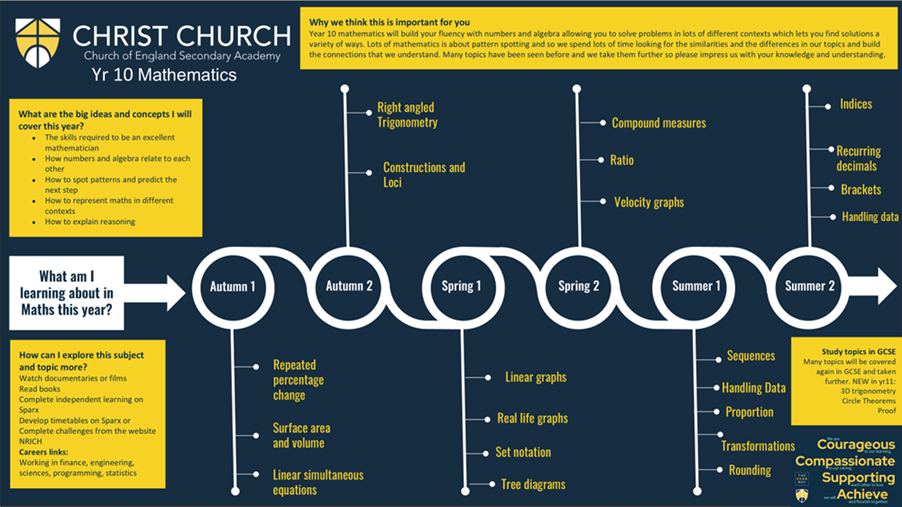
What will students study in Year 10?
| Term | Content | Assessment Topics for revision |
| Term 1 | Percentages, Surface area and volume, Simultaneous equations, Formulae, Trigonometry, Constructions | U332 U988 U871 U523 U893 U561 U484 U116 U617 U543 U760 U757 U836 U137 U181 U605 U283 U545 U627 U164 U820 |
| Term 2 | Linear graphs, Real-life graphs, Set notation, Tree diagrams, Compound measures, Ratio, Graphs | U477 U848 U377 U652 U638 U862 U748 U296 U558 U729 U910 U527 U921 U676 U865 U937 U562 U980 U593 |
| Term 3 | Sequences, Handling data, Proportion, Transformations, Rounding, Indices, Brackets, Handling data and statistical diagrams | U498 U978 U958 U162 U640 U364 U238 U766 U657 U301 U235 U694 U662 U768 U963 U228 U312 U877 U200 U909 U590 U193 U840 |
How is your child assessed?
Your child is assessed through topic tests at the end of each unit (for example, after key topics such as percentages, trigonometry, or graphs) and through termly mock exams that combine questions from multiple areas. These assessments allow tracking of both topic-specific mastery and overall progress across the year.
Pushing for Progress
Each term builds on key GCSE skills:
Term 1 strengthens core foundations such as algebraic manipulation and geometry (e.g., simultaneous equations, trigonometry, and constructions).
Term 2 focuses on applying reasoning to real-life contexts and data handling (e.g., linear and real-life graphs, ratios, and probability).
Term 3 develops higher-order thinking and problem-solving skills through topics like sequences, indices, proportion, and transformations.
Students are encouraged to review feedback from topic tests, revisit weaker areas, and practise mixed exam-style questions to develop fluency and confidence
How might you help at home?
Encourage your child to regularly review class notes and use revision booklets or online platforms (such as Maths Genie’s GCSE practice or DrFrostMaths) for independent practice.
Help set a structured revision schedule, focusing extra time on topics flagged in recent assessments (for example, ratios or statistical diagrams).
Prompt your child to explain methods aloud—teaching a concept is one of the best ways to solidify understanding.
Support completion of homework and targeted revision tasks set by teachers.
Provide encouragement and maintain positive motivation, especially before mock exams.
Homework
Christ Church Secondary Academy – Sparx Maths
Students are expected to complete their weekly maths home learning using the online platform Sparx Maths.
Sparx Maths is a personalised programme that sets, checks and tracks homework automatically. It adapts to each student’s level of understanding, ensuring the work is both achievable and appropriately challenging. This helps students grow in confidence and make steady progress in mathematics.
Our approach to home learning reflects our school values:
- Flourishing Futures – preparing students for success in school and beyond
- Collaboration – families and school working together to support learning
- Compassion – recognising that students progress at different rates
- Strength – building perseverance through regular practice
- Aspiration – encouraging students to aim high in their learning
How does Sparx Maths home learning work?
- Each week, Sparx creates a personalised set of questions based on your child’s current level of understanding, confidence and pace of learning.
- The questions are designed to be accessible while still providing appropriate challenge so students can make progress.
- Every question includes short help videos and guidance so students can get support when they are unsure.
- With the support available, students are expected to complete their homework accurately.
How can I support my child?
We know families want to help with maths homework. Please encourage your child to try each question independently first.
Independent practice allows Sparx to identify strengths and gaps so future homework remains correctly matched to your child’s needs.
If a question generates a purple “seek help” notification, students may then ask a parent, carer, older sibling or teacher for support.
Why is this homework important?
Regular, personalised practice helps students secure the key building blocks of mathematics. Sparx supports students to revisit, practise and strengthen their understanding so learning becomes secure and long‑lasting.
Consistent homework completion also builds positive study habits and resilience.
We recommend that students complete their homework early in the week, giving them time to ask for help from their teacher if needed before the deadline.
What support is available?
Support is available through:
- Maths teachers, who can provide guidance on challenging topics
- Help videos on the Sparx platform
- Catch‑up or support sessions run by the Maths Department
Rewards for consistent completion
We believe that effort and commitment should be recognised and celebrated. Students who complete their Sparx Maths homework consistently may receive:
- Praise and positive recognition from their Maths teacher
- Positive behaviour points for completing homework on time
- Certificates or acknowledgement in assemblies
- Opportunities for class‑based or year‑group rewards
- Recognition for high XP Points through Sparx challenges or school systems
These rewards help motivate students and celebrate the hard work they put into their learning.
Sanctions if homework is not completed
Sparx Maths is compulsory weekly homework for all students.
If homework is not completed:
- Students will be required to attend a catch‑up session during break, lunch or after school so they can complete the work with support.
- If homework is missed on multiple occasions, a detention will be issued in line with the school’s behaviour and homework policy.
- Parents and carers may be contacted if a student repeatedly does not engage with their home learning.
This approach ensures that students are supported to develop strong learning routines while also being held accountable for their effort.
What if my child finishes early?
Sparx also offers optional practice and challenge activities:
- XP Boost – revision questions from previously taught topics
- Target – extension questions to stretch students further
Students earn XP Points for all completed tasks, which contribute to class and school recognition systems and celebrate their commitment.
Year 11
Curriculum intention and building on prior learning
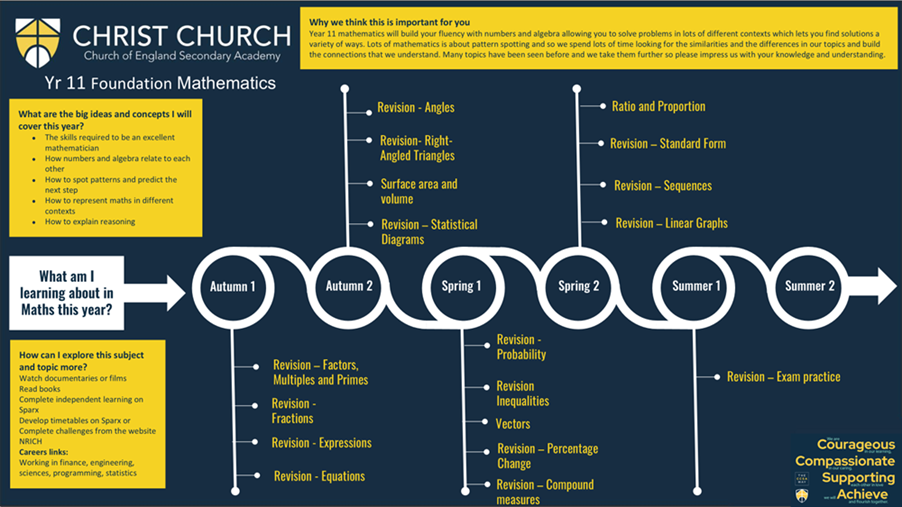
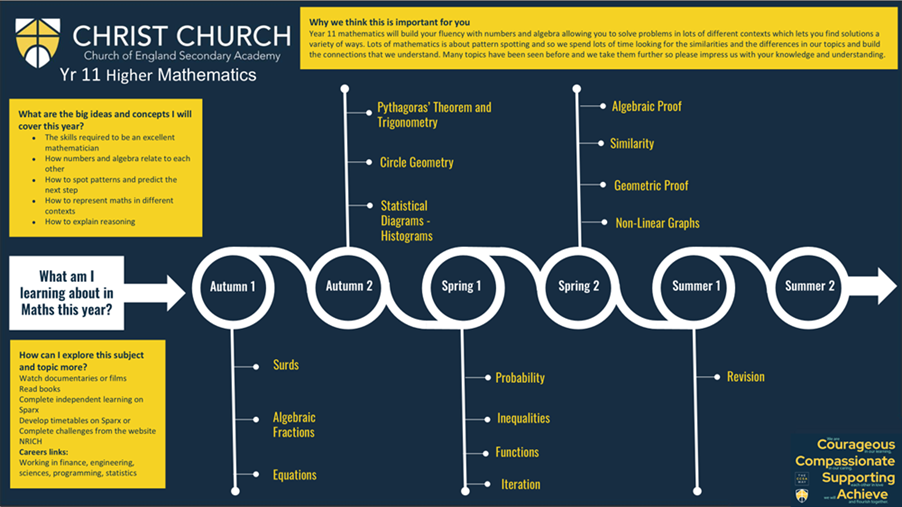
What will students study in Year 11?
| Term | Content (Foundation) | Sparx Topics for revision (Foundation) | Content (Higher) | Sparx Topics for revision (Higher) |
| Term 1 | Factors, multiples and primes, Fractions, Expressions, Equations, Angles, Right-angled triangles, Surface area and volume, Statistical diagrams | U683 U104 U166 U748 U296 U558 U729 U580 U738 U145 U337 U903 U564 U660 U781 U671 U286 U278 U332 U988 U151 U256 U910 U527 U921 U676 U865 U721 U357 U610 U264 U290 U161 U498 U978 U958 U680 U741 U315 U669 U477 U848 U377 | Calculating with surds, Rationalising denominators, Calculating with algebraic fractions, Calculating with surds, Rationalising denominators, Trigonometric ratios and graphs, Non right-angled trigonometry, 3D Pythagoras’ theorem and trigonometry, Circle theorems, Histograms | U633 U338 U872 U499 U707 U281 U437 U294 U685 U457 U824 U633 U338 U872 U499 U707 U281 U319 U450 U952 U591 U592 U541 U170 U459 U251 U489 U130 U185 U814 U983 U267 |
| Term 2 | Probability, Inequalities, Vectors, Percentages, Compound measures, Ratio and proportion, Standard form, Sequences, Linear graphs | U751 U529 U739 U250 U439 U793 U224 U538 U662 U103 U325 U870 U505 U599 U228 U601 U760 U757 U836 U137 U655 U826 U329 U427 U385 U828 U283 U545 U627 U967 U107 U164 U771 U561 U426 U543 U508 U172 U199 U277 U128 | Probability, Inequalities, Functions, Transformations, Iteration, Algebraic proof, Similarity, Geometric proof, Graphs | U246 U699 U821 U806 U369 U747 U133 U637 U895 U448 U996 U598 U487 U455 U171 U434 U168 U582 U630 U110 U781 U560 U471 U887 U807 U800 U611 U882 U567 |
How is your child assessed?
Your child is assessed through regular topic-based checks in class, alongside three main mock exam windows in September, November and February across all GCSE maths papers.
These mocks are used to:
- Provide realistic exam practice under timed conditions.
- Identify strengths and gaps so that teaching and revision can be adjusted before the final exams.
- Inform predictions and decisions about tier of entry (Foundation or Higher) where appropriate.
How might you help at home?
Encourage your child to regularly review class notes and use revision booklets or online platforms (such as Maths Genie’s GCSE practice or DrFrostMaths) for independent practice.
Help set a structured revision schedule, focusing extra time on topics flagged in recent assessments (for example, ratios or statistical diagrams).
Prompt your child to explain methods aloud—teaching a concept is one of the best ways to solidify understanding.
Support completion of homework and targeted revision tasks set by teachers.
Provide encouragement and maintain positive motivation, especially before mock exams.
Homework
Homework will be set as weekly paper-based exam-style question packs, designed to mirror the format and difficulty of GCSE papers.
- Students will receive a short set of mixed questions each week, covering recent class topics and key GCSE skills.
- These will be handed in for marking, with feedback used to identify misconceptions and inform reteaching or targeted revision.
- Over time, the questions will increasingly resemble full exam items, helping students build stamina, accuracy, and confidence for the final papers.