


History
Name of Course: Pearson Edexcel GCSE History (9-1)
Head of Department: Karen O’Connor
Exam board website: Pearson Edexcel GCSE History (9-1)
Specification: Pearson Edexcel GCSE History (9-1) Specification
Key Stage Three Curriculum
The History Department at Christ Church Secondary Academy (CCSA) will develop confident historians who have an appreciation of the historical context and development of the local, national and global context of the world in which they live so that they can flourish as citizens in modern Britain. The history curriculum at CCSA is driven and underpinned by our school values of supporting all learners to be courageous in this approach to history, developing compassion to their community and the wider world so that students are able to achieve and fulfil their potential.
To support our students to be curious learners we:-
- Plan and deliver an ambitious and diverse history curriculum which is centred around the broad historical knowledge that students need to know but also we aim to ensure that our students have access to historical knowledge that will broaden their horizons.
- Literacy will be at the heart of learning in history – reading, writing and oracy – and our lessons have been planned and designed to ensure that all students are consistently developing each of these aspects of literacy.
- We will ensure that that students have a variety of opportunities to practice using the historical knowledge that they have learned through our curriculum.
- We have high expectations for each and every student that we teach and we firmly believe that each student deserves access to a rich, broad, diverse and ambitious history curriculum where every student has the opportunity to achieve at the highest possible level.
Key Stage Four Curriculum
Course content
Edexcel GCSE History will cover the following four topics:-
- Thematic study and historic environment—Crime and punishment in Britian, c1000 to present and Whitechapel, c1870 to c1900
- Period study—Superpower relations and the Cold War, 1941 to 1991
- British depth study—Early Elizabethan England, 1558 to 1588
- Modern depth study—Weimar and Nazi Germany, 1918 to 1939
To give you a flavour of the content that you will study the links above will take you to the excellent BBC Bitesize page for each exam topic.
Assessment details
| Paper | Paper 1 | Paper 2 | Paper 3 |
| Topic | Thematic study and historic environment – Crime and punishment in Britain, c1000 to present and Whitechapel, c1870 to c1900 | Period study, Superpower Relations and the Cold War, 1941-91 British depth study, Early Elizabethan England, 1558-1588 | Modern depth study, Weimar and Nazi Germany, 1918-39 |
| Question types | Essay and source questions | Essay questions | Essay, source and interpretation questions |
| Worth? | 30% of final grade | 40% of final grade | 30% of final grade |
Why study this course?
To study GCSE history is to explore the fascinating story of the past, become a critical thinker, excellent researcher and effective written communicator. Over the two years of studying GCSE history you will learn how to explain, analyse and evaluate, engage with historical texts. However, GCSE history is not just about academics, it is also essential to help us to understand the world that we live in today and also provides an excellent gateway to many diverse careers and cultural opportunities. The most common areas that those who study history work in include, the civil service, teaching, academia, law, diplomacy, development, museums and culture. However, some history students are known to work in communications, politics and financial services – the list is truly endless! To help you to understand the endless variety of jobs open to history students have a look at the career stories for history on BBC Bitesize.
Year 7
Curriculum intention and building on prior learning
The CCSA Year 7 History curriculum builds confidently and purposefully on the National Curriculum for KS1–KS2 by extending pupils’ chronological understanding from the world of Edward the Confessor into the transformative events of 1066 and beyond, fulfilling the KS2 expectation to study history “beyond 1066”. It strengthens the key historical concepts—cause and consequence, continuity and change, significance, and similarity and difference—that pupils begin developing in primary school, aligning with the National Curriculum’s emphasis on these disciplinary ideas. By exploring the Norman Conquest, medieval power and society, and the early Tudors, the CCSA curriculum builds positively on pupils’ prior knowledge of Romans, Anglo‑Saxons, and Vikings, while promoting increasingly confident use of evidence, interpretation, and extended historical writing, as encouraged by the National Curriculum’s expectations for progression.
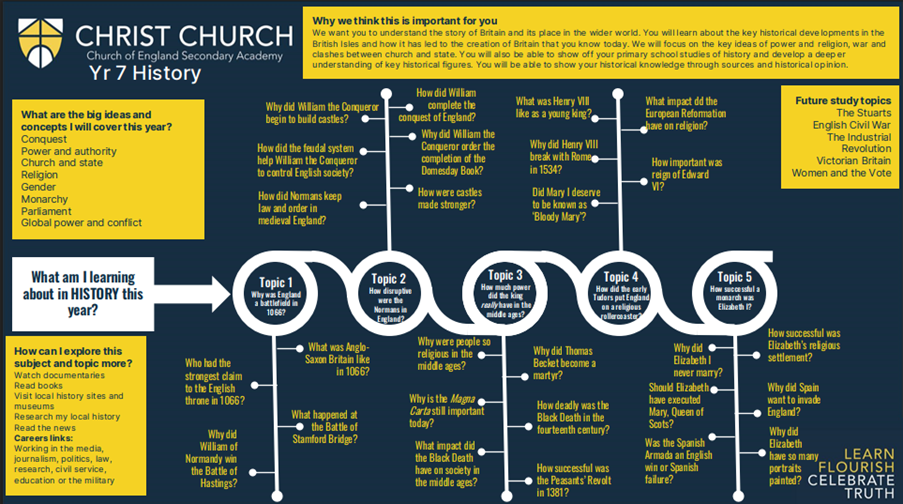
What will students study in Year 7?
| Term | Content | Assessment Topics for revision |
| Term 1 | Why was England a battlefield in 1066? How disruptive were the Normans in England? | Britain in 1066 Contenders to the throne Battle of Stamford Bridge Battle of Hastings Norman Conquest Motte and Bailey Castles Feudal System Domesday Book Stone castles Law and order in the middle ages |
| Term 2 | How much power did the king really have in the middle ages? How did the early Tudors put England on a religious rollercoaster? | Religion in the middle ages Thomas Becket King John and the Magna Carta Development of Parliament Black Death and its consequences Peasants’ Revolt Young Henry VIII European Reformation Henry VIII’s Break with Rome Edward VI Mary I |
| Term 3 | How successful a monarch was Elizabeth I? | Elizabeth and marriage Religious settlement Mary, Queen of Scots Causes of the Spanish Armada Spanish Armada |
How is your child assessed?
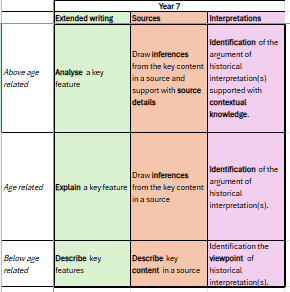
At CCSA, we design our Year 7 assessments so that parents, pupils and teachers can clearly see how learning is developing across the year. Our end‑point expectations outline what successful historians in Year 7 should be able to do—explain key historical features, draw simple but accurate inferences from sources and identify the main argument in an historical interpretation—and our assessments mirror these skills directly. The assessment pupils complete brings together everything they have learned across the medieval England unit, with sections on vocabulary, knowledge, source analysis, interpretations and an extended written response that asks them to explain a key aspect of Norman control, exactly as described in the Year 7 end‑points. Extended writing is nurtured throughout lessons: pupils regularly practise structured explanations, use tailored success criteria and engage with whole‑class feedback to improve their clarity, accuracy and use of evidence. This steady, well‑supported practice means that by the time pupils reach the assessment, they are confident in producing thoughtful, well‑organised written historical arguments that show real progress as young historians.
Pushing for Progress
- Show curiosity by reading short articles, fact‑files or books about castles, the Normans or the Tudors beyond lesson content.
- Practise explaining historical events out loud using key vocabulary from lessons to strengthen clarity and accuracy.
- Explore historical stories, documentaries or museum virtual tours related to medieval life to deepen contextual understanding.
- Try writing short “mini‑explanations” at home (e.g., Why did William win? or Why was the Feudal System important?) to develop confidence with extended responses.
- Challenge themselves with additional Educake quizzes or revision cards to further embed key knowledge and build fluent recall.
How might you help at home?
- Talk with your child about what they learned in History each week to help them build confidence.
- Encourage them to revisit key vocabulary and explain events in their own words.
- Support them in completing their weekly Educake quiz to help embed essential knowledge.
- Celebrate small successes—building strong foundations now sets them up well for Years 8 and 9.
Homework
At CCSA History, we set weekly Educake quizzes to help pupils embed key historical knowledge with ease and confidence. Short, focused questions revisit recent learning and earlier content to strengthen foundations, while instant feedback lets pupils see their progress and refine answers straight away. It’s a simple, positive routine that builds confidence, deepens long‑term understanding, and supports every child to thrive in History.
Year 8
Curriculum intention and building on prior learning
The CCSA Year 8 History curriculum powerfully extends pupils’ progress by building on the KS1–KS2 National Curriculum expectation for a coherent chronological narrative “beyond 1066” and the disciplined use of historical concepts and evidence, then advancing the knowledge and skills secured through the CCSA Year 7 curriculum (Norman conquest, medieval power, early Tudors) into richer early‑modern, imperial and industrial enquiries (Elizabeth I, seventeenth‑century revolution, slavery and emancipation, colonial India, Industrial Revolution); this coherent sequence strengthens pupils’ grasp of cause and consequence, change and continuity, significance, similarity and difference, and promotes more confident source analysis, interpretation and extended writing—fully aligned with National Curriculum aims and clearly sequenced from Year 7’s foundations to Year 8’s greater breadth and complexity.
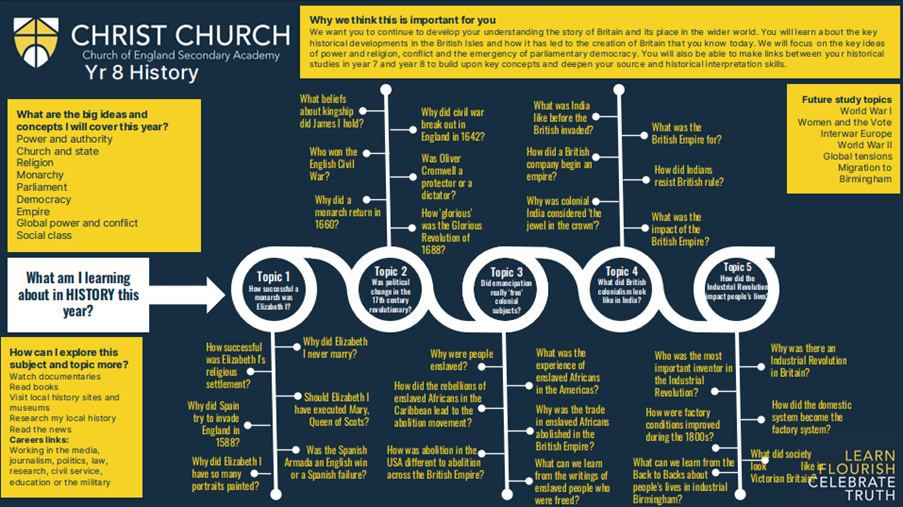
What will students study in Year 8?
| Term | Content | Assessment Topics for revision |
| Term 1 | How successful a monarch was Elizabeth I? How revolutionary was change in the 1600s? | Elizabeth and marriage Religious settlement Mary, Queen of Scots Causes of the Spanish Armada Spanish Armada James I Causes of the English Civil War Key events of the English Civil War Cromwell and the Interregnum The Restoration The Glorious Revolution |
| Term 2 | Did emancipation really ‘free’ colonial subjects? What did British colonialism look like in India? | West African Kingdoms Causes of enslavement Experiences of enslaved Africans in the Americas Slave Rebellions Abolition in Britain Abolition in the USA Mughal India British Empire East India Company Indian resistance to British rule British Raj Impact of empire on India and Britain |
| Term 3 | How did the Industrial Revolution impact people’s lives? How did women get the vote? | Causes of the Industrial Revolution Inventors of the Industrial Revolution Domestic and factory systems Improvement of factory conditions in the 1800s Victorian society Birmingham’s Back to Backs Lives of Victorian women Suffragists and Suffragettes Tactics of the Suffragists and Suffragettes Women in WWI and gaining the vote |
How is your child assessed?
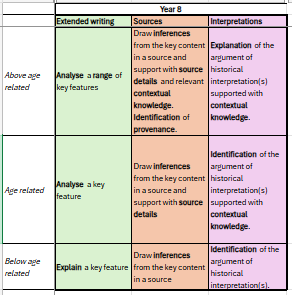
At CCSA, our Year 8 History assessment is designed to build naturally on pupils’ growing skills and confidence, closely following the progression set out in our Year 8 KS3 End Points. By this stage, pupils are expected to analyse a wider range of historical features, support their source inferences with contextual knowledge, and explain the arguments behind interpretations—not just identify them as they did in Year 7. The assessment reflects this growth: pupils begin by demonstrating secure knowledge of the curriculum topics before moving into more demanding source and interpretation tasks. Extended writing continues to play a central role in lessons, where pupils practise developing structured, evidence‑rich arguments using clear success criteria and whole‑class feedback, ensuring they are fully prepared for extended writing in the assessment. By the time pupils reach this point, they are confidently writing balanced, well‑supported explanations that show real progression from Year 7 and lay strong foundations for the analytical demands of Year 9.
Pushing for Progress
- Read or watch age‑appropriate material about Elizabeth I, the English Civil War, the Slave Trade or the British Empire to broaden understanding beyond the classroom.
- Practise comparing two causes or two viewpoints at home to build the analytical writing skills expected at this stage of the end‑points.
- Engage in thoughtful discussions about fairness, change or power to strengthen evaluative thinking.
- Experiment with writing longer paragraphs that include evidence, explanation and a developing judgement—mirroring the Year 8 extended writing expectation.
- Take on optional research tasks such as creating timelines, biographies or debates to enrich understanding of early modern and imperial history.
How might you help at home?
- Ask your child questions such as “Why do you think that happened?” to develop their analytical thinking.
- Encourage them to complete their weekly Educake quiz to strengthen knowledge recall.
- Explore documentaries, podcasts or reading linked to their topics if they show interest.
- Help them talk through different viewpoints to deepen their understanding of more complex ideas.
Homework
At CCSA History, we set weekly Educake quizzes to help pupils embed key historical knowledge with ease and confidence. Short, focused questions revisit recent learning and earlier content to strengthen foundations, while instant feedback lets pupils see their progress and refine answers straight away. It’s a simple, positive routine that builds confidence, deepens long‑term understanding, and supports every child to thrive in History.
Year 9
Curriculum intention and building on prior learning
The CCSA Year 9 History curriculum builds strongly on the KS1–KS2 National Curriculum (coherent chronology; secure grasp of cause, consequence, change, continuity, similarity/difference, and significance) by extending learning “beyond 1066” into compelling twentieth‑century enquiries (WWI, women’s suffrage, WWII, decolonisation, migration), while deliberately advancing the disciplinary reading, source evaluation, interpretations work and extended writing established in the CCSA Year 7 and Year 8 programmes (medieval power and religion; early modern state and empire; industrial and imperial change) to tackle modern global history with greater breadth and rigour. This progression equips pupils with the knowledge and skills demanded by Edexcel GCSE History thereby preparing them confidently for the assessment model and content choices outlined in the specification and support materials.
What will students study in Year 9?
| Term | Content | Assessment Topics for revision |
| Term 1 | Why was the First World War considered the “war that will end war”? How did women get the vote? | Causes of World War I Recruitment and conscription Life in the trenches End of the First World War World War I peace settlement Lives of Victorian women Suffragists and Suffragettes Tactics of the Suffragists and Suffragettes Women in WWI and gaining the vote |
| Term 2 | How did the world wars shape the modern world? How did Britain’s colonies break free during the twentieth century? | International relations leading to World War I Hitler as a cause of World War I Key events of World War I The Holocaust Nuclear arms race Cold War and Superpower Relations Decolonisation Partition of Ireland Britain in the Middle East Partition of India Independence in Africa Empire Windrush |
| Term 3 | How has Birmingham become Britain’s first majority-minority city? | Migration and migration to the West Midlands Irish migration New Commonwealth migration Eastern European migration Legacy of migration |
How is your child assessed?
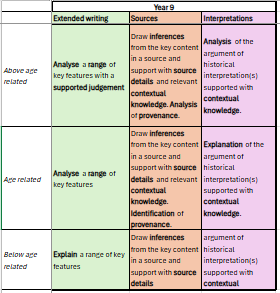
At CCSA, our Year 9 History assessment is designed to showcase the culmination of pupils’ progress across Key Stage 3, closely reflecting the expectations set out in our KS3 end‑points. By this stage, pupils are expected to analyse a wide range of key features with supported judgement, draw inferences from sources using contextual knowledge and provenance, and explain and evaluate interpretations confidently—all of which sit at the heart of the Year 9 descriptors in the progression document. Our assessment structure mirrors these expectations, giving pupils the opportunity to demonstrate mature historical thinking through secure knowledge, thoughtful source work and balanced evaluative writing, all aligned with the skills they have steadily developed since Year 7. Extended writing continues to be nurtured throughout lessons: pupils practise constructing well‑reasoned arguments, are guided by clear success criteria and benefit from whole‑class feedback so they can refine their responses. By the time they reach the assessment, pupils are able to communicate sophisticated, well‑supported historical judgements with confidence, fully demonstrating the independence and analytical depth expected at the end of KS3.
Pushing for Progress
- Explore high‑quality documentaries, books or podcasts on World War I, suffrage, World War II, the Holocaust, decolonisation or migration to build breadth and context.
- Practise GCSE‑style thinking by weighing up two interpretations, two causes or two consequences at home—matching Year 9 expectations for supported judgement from the KS3 end‑points.
- Attempt more sophisticated extended writing, such as constructing balanced arguments that include counterpoints and reach a justified conclusion.
- Read historical sources (letters, posters, speeches) and discuss their purpose, audience and reliability to strengthen source evaluation.
- Make links between different periods—e.g., how empire shaped both WWI and decolonisation—to develop the big‑picture thinking that prepares them for GCSE.
How might you help at home?
- Discuss the bigger themes they study—conflict, democracy, empire, migration—to support deeper thinking.
- Encourage your child to give explanations and justify their opinions with evidence.
- Make sure they keep up with their weekly Educake quiz to secure the knowledge needed for GCSE.
- Help them compare different historical viewpoints or events to build strong evaluative skills.
Homework
At CCSA History, we set weekly Educake quizzes to help pupils embed key historical knowledge with ease and confidence. Short, focused questions revisit recent learning and earlier content to strengthen foundations, while instant feedback lets pupils see their progress and refine answers straight away. It’s a simple, positive routine that builds confidence, deepens long‑term understanding, and supports every child to thrive in History.