


Geography
Name of Course: GCSE Geography (Eduqas B)
Head of Department: F. Cattell
Exam board website: Eduqas GCSE Geography B Exam Board Website
Geography at CCSA enables students to become global citizens, to understand their place in the world. It allows students to develop compassion when considering how people live their lives in variety of locations, understand the processes that affect the world and evaluate the role that humans play in influencing physical processes, people and communities. Students will fully understand how we can all have a positive impact on Earth now and in the future.
Course content: This course follows the Eduqas GCSE Geography B specification, which provides a thematic approach to studying geography. Topics include challenges in the natural world, environmental sustainability, and the human impact on the planet. Students will explore local, national, and global issues to understand the complex interconnections between people and their environments.
The course is divided into three sections:
Changing Physical and Human Landscapes – Study of coasts, rivers, and urban environments.
Environmental and Development Issues – Exploring global climate change, natural hazards, and the challenges of development.
Applied Fieldwork – A practical element where students will conduct fieldwork investigations and apply their findings to real-world geographical issues.
Students will develop a deep understanding of global challenges, their local impacts, and how these issues shape our world.
Assessment details:
The course is assessed through three exams:
Component 1: Investigating Geographical Issues (40%) – A written exam based on core geographical themes.
Component 2: Problem-Solving Geography (30%) – An exam focused on applying geographical skills to real-world scenarios.
Component 3: Applied Fieldwork Enquiry (30%) – An assessment based on the fieldwork investigation conducted during the course.
Why study this course?
Geography helps us make sense of the world around us. It teaches important skills like data analysis, critical thinking, and problem-solving, all while exploring key topics such as climate change, resource management, and sustainability. Studying geography equips students with a well-rounded knowledge of how natural and human systems interact, fostering an understanding that is crucial for tackling global challenges.
Key Stage Three Curriculum
Year 7
Curriculum Intention – Year 7 Geography
Our Year 7 Geography curriculum is designed to help learners understand the world they live in and their place within it. Students explore the geography of the UK and the wider world, beginning to recognise how people, places and environments are connected. Through a sequence of carefully planned topics—ranging from world regions and climate to China’s economy, globalisation, rainforests and environmental issues—students develop curiosity, critical thinking and an appreciation of both human and physical geography.
We aim to build the foundations of excellent geographical understanding by developing core skills in map‑reading, data interpretation, decision‑making and extended writing. Students are encouraged to reflect on how geographical processes shape the modern world and to consider their own role in caring for the planet. Throughout Year 7, learners engage with contemporary global issues such as fast fashion, population change, sustainable living and plastic pollution, helping them to become informed and responsible global citizens.
Building on Prior Learning
Our Year 7 curriculum builds on geographical knowledge and skills introduced at primary school. Students deepen their understanding of continents, countries, weather and climate, while extending their locational knowledge through the study of diverse global landscapes such as Antarctica, Indonesia, the Grand Canyon and the Amazon Rainforest.
The curriculum is sequenced to ensure concepts grow in complexity over time. Learners begin with fundamental ideas about world regions and UK geography before moving into more demanding themes such as globalisation, population dynamics and environmental challenges. Each unit connects to previous learning—for example, map skills support work on world biomes, and earlier exploration of economic activity helps students later examine fast fashion and TNCs.
This structured progression ensures students can confidently build new knowledge on secure foundations, preparing them for deeper geographical enquiry in Years 8 and 9.
What will students study in Year 7?
| Term | Content | Assessment Topics for Revision |
| Term 1 | World Regions and Continents — Antarctica, Indonesian volcanoes, Iguazu Falls, The Great Barrier Reef, The Grand Canyon What is Geography? (introduction to physical & human geography) UK Geography — UK Climate, UK Urban Geography | World Regions & Continents Introduction to Geography UK Geography |
| Term 2 | Our Shrinking World — global connectivity and the impact of TNCs Sustainable Fashion — fast fashion, Fairtrade Our World and China — industry in China, population density, economic growth, China’s place in the world | Globalisation & Shrinking World Fast Fashion & Sustainability China’s Economy & Population |
| Term 3 | World Biomes — characteristics of major biomes Rainforests — how rainforests help people, where they are, human uses Environmental Issues — plastic pollution, plastics in oceans, plastics in ecosystems | World Biomes Rainforests Environmental Issues (Plastic Pollution) |
How is your child assessed?
In Geography, students are formally assessed twice per academic year. These assessment points are designed to measure progress and understanding of the topics studied up to that point.
Each assessment covers the knowledge and skills from the units taught during that period. Assessments include a mixture of:
- Short-answer knowledge questions
- Skills-based questions (such as interpreting graphs, maps or data)
- Extended writing questions where students explain, analyse and evaluate geographical issues
This range of question types ensures that students are assessed on both their subject knowledge and their ability to apply geographical skills, think critically and construct well-supported arguments.
Pushing for Progress
In Year 7 Geography, students are supported to continually improve their knowledge, skills and confidence. Progress is encouraged through:
- Regular retrieval practice to strengthen memory of key knowledge.
- Clear feedback following assessments, identifying strengths and next steps.
- Opportunities to improve extended writing using structured guidance.
- Development of map skills, data interpretation and geographical vocabulary.
- Stretch and challenge tasks to deepen understanding of global issues.
Students are encouraged to reflect on feedback and actively respond to improve their work.
How might you help at home?
Parents and carers can support progress in Geography by:
- Encouraging regular revision of key vocabulary and case studies.
- Testing knowledge using knowledge organisers.
- Discussing geographical issues in the news (e.g. climate change, global trade, plastic pollution).
- Using atlases or online maps to improve place knowledge.
- Watching age-appropriate documentaries about world regions, rainforests or globalisation.
- Supporting completion of homework to a high standard.
Homework
Homework is set regularly to consolidate and extend classroom learning. It is set weekly on the platform Educake. Tasks may include:
- Retrieval quizzes and knowledge-based tasks
- Research on world regions or environmental issues
- Map skills practice
- Preparation for assessments
Homework is designed to build independence and reinforce key geographical knowledge and skills.
Year 8
Curriculum Intention
The Year 8 Geography curriculum is designed to help students understand how the physical and human world are connected and how these connections shape people’s lives at different scales.
Throughout the year, students:
- Develop knowledge of physical processes such as tectonic activity, earthquakes, volcanoes, tsunamis, coastal processes and landforms.
- Explore human geography themes including development, global cities, migration, population change and urban growth.
- Understand sustainable development, especially through the case study of Birmingham.
- Investigate the UK coastline, including how it is changing and how it is managed.
- Use important geographical skills such as:
- Interpreting maps and graphs
- Analysing development indicators
- Using GIS
- Collecting and presenting fieldwork data
By the end of Year 8, students will be able to:
- Explain causes and effects of natural hazards.
- Describe why development is uneven across the world.
- Compare HICs and LICs using development indicators.
- Explain population change and migration.
- Describe coastal processes and how coastlines are managed.
- Make links between people, places and environments.
- Think critically about sustainability and the future of the planet.
Building on Prior Learning
Year 8 builds directly on the foundations laid in Year 7 and prepares students for Year 9 and GCSE.
Building on Year 7
Students extend their understanding of:
- Biomes and ecosystems → Now linking climate and environment to development and population.
- Global cities → Deepening this through migration, urban growth and Birmingham as a case study.
- Sustainability → Applying this to development and coastal management.
- Map and graph skills → Using more complex data and development indicators such as HDI.
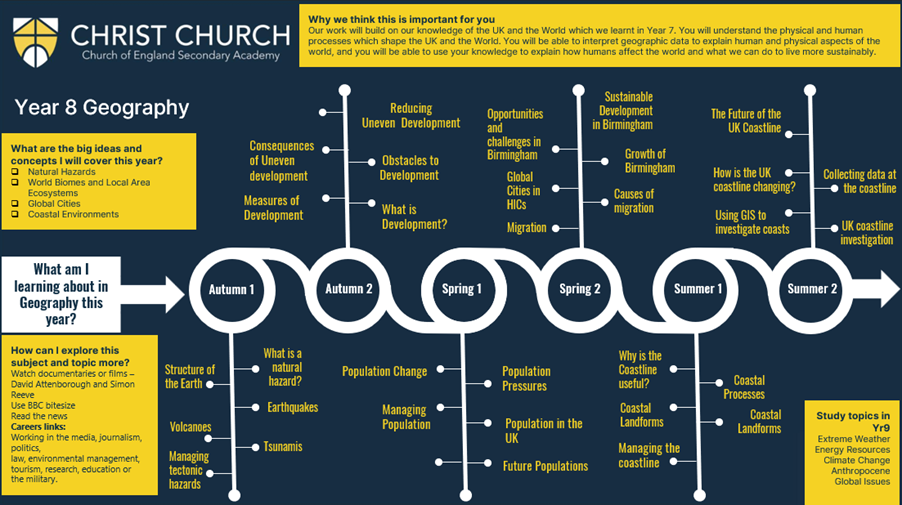
What will students study in Year 8?
| Term | Content | Assessment Topics for revision |
| Term 1 | Development and Tectonic Hazards What is development? Measuring development (HDI, GNI, literacy, life expectancy) Uneven development and obstacles to development Reducing the development gap Structure of the Earth Plate tectonics Earthquakes, volcanoes and tsunamis Managing tectonic hazards | Definitions of development and sustainability Using and interpreting development indicators Causes and consequences of uneven development Structure of the Earth diagram Causes and impacts of earthquakes and volcanoes Hazard management strategies |
| Term 2 | Population and Urban Change Population change (birth rate, death rate, natural increase) Managing population growth and decline Migration (push and pull factors) Global cities in HICs Opportunities and challenges in Birmingham Sustainable development in Birmingham Causes of migration and urban growth | Population pyramids Push and pull factors of migration Impacts of migration Birmingham case study knowledge Sustainable city strategies |
| Term 3 | The UK Rivers and Coastline Why coasts and rivers are important River and coastal processes (erosion, transportation, deposition) River and coastal landforms Managing UK rivers and the coastline Using GIS to investigate coasts and rivers | Key coastal and rivers process definitions Formation of coastal and river landforms Advantages and disadvantages of coastal and river management Links between climate change and river and coastal management |
How is your child assessed?
In Geography, students are formally assessed twice per academic year. These assessment points are designed to measure progress and understanding of the topics studied up to that point.
Each assessment covers the knowledge and skills from the units taught during that period. Assessments include a mixture of:
- Short-answer knowledge questions
- Skills-based questions (such as interpreting graphs, maps or data)
- Extended writing questions where students explain, analyse and evaluate geographical issues
This range of question types ensures that students are assessed on both their subject knowledge and their ability to apply geographical skills, think critically and construct well-supported arguments
Across the year, assessments will cover:
- Development and uneven development
- Tectonic hazards (earthquakes, volcanoes, tsunamis)
- Population change and migration
- Birmingham as a case study
- Coastal processes, landforms and management
Students are assessed on their ability to:
- Use key geographical vocabulary accurately
- Describe and explain processes clearly
- Use case study evidence
- Interpret maps, graphs and data
- Make links between human and physical geography
Pushing for Progress
In Year 8 Geography, students are supported to continually improve their knowledge, skills and confidence. Progress is encouraged through:
- Regular retrieval practice to strengthen memory of key knowledge.
- Clear feedback following assessments, identifying strengths and next steps.
- Opportunities to improve extended writing using structured guidance.
- Development of map skills, data interpretation and geographical vocabulary.
- Stretch and challenge tasks to deepen understanding of global issues.
- Develop answers using PEEL-style paragraphs
Students are encouraged to reflect on feedback and actively respond to improve their work.
How might you help at home?
You can support your child by:
- Encouraging them to revise key vocabulary regularly
- Testing them on definitions (development, tectonics, migration, erosion)
- Asking them to explain a process in their own words
- Watching documentaries together (e.g. David Attenborough)
- Discussing news stories about natural hazards or global issues
- Using BBC Bitesize for recap activities
Homework
Homework is set regularly to consolidate and extend classroom learning. It is set weekly on the platform Educake. Tasks may include:
- Retrieval quizzes and knowledge-based tasks
- Research on world regions or environmental issues
- Map skills practice
- Preparation for assessments
Homework is designed to build independence and reinforce key geographical knowledge and skills.
Year 9
Curriculum Intention
In Year 9, students explore some of the most important challenges facing our planet. The curriculum builds on knowledge from Years 7 and 8 and prepares students for GCSE Geography (Key Stage 4).
Students investigate:
- Rivers and flooding in the UK
- Extreme weather including hurricanes, droughts and monsoons
- Climate change, the carbon cycle and the greenhouse effect
- Energy resources – fossil fuels and renewable energy
- The Anthropocene and human impact on the planet
- Global issues, including conflict and tourism
Throughout the year, students develop their ability to explain complex processes, analyse data, evaluate different viewpoints and apply knowledge to real-world issues.
Building on Prior Learning
Year 9 strengthens and deepens understanding from Years 7 and 8.
Students build on prior learning about:
- Physical processes (tectonics, coasts and hazards)
- Development and sustainability
- Population and urban change
They move from describing and explaining to:
- Evaluating solutions
- Making evidence-based decisions
- Linking human and physical geography together
Year 9 acts as a bridge to GCSE by developing extended writing, case study knowledge, data interpretation and critical thinking skills.
What will students study in Year 9?
| Term | Content | Assessment Topics for revision |
| Term 1 | River landforms and processes Drainage basins Local river study Flood management in the UK What is weather and climate? Hurricanes, tornadoes, monsoons Drought and wildfires Why is extreme weather becoming more frequent? | Drainage basin features River processes (erosion, transportation, deposition) Causes and impacts of flooding Causes and impacts of extreme weather Climate vs weather Links between climate change and extreme events |
| Term 2 | Energy as a vital resource Fossil fuels Renewable energy Energy production and consumption Impacts of fossil fuel use Sustainable energy in the UK The Carbon Cycle Natural vs human causes of climate change The Greenhouse Effect Global impacts of climate change Tackling the climate emergency | Advantages and disadvantages of different energy types Environmental impacts of fossil fuels The Carbon Cycle diagram Causes of climate change Greenhouse Effect explanation Impacts of climate change (social, economic, environmental) Strategies to reduce climate change |
| Term 3 | What is the Anthropocene? Human impact on the planet Geography and the Anthropocene Can we reduce the effects of humans? Sustainable development Tourism in the Maldives The geography of the Middle East Decision-making exercises | Definition and evidence for the Anthropocene Impacts of human activity Sustainable development strategies Case study knowledge (Maldives tourism, Middle East) Evaluating solutions Decision-making skills and extended writing |
How is your child assessed?
In Geography, students are formally assessed twice per academic year. These assessment points are designed to measure progress and understanding of the topics studied up to that point.
Each assessment covers the knowledge and skills from the units taught during that period. Assessments include a mixture of:
- Short-answer knowledge questions
- Skills-based questions (such as interpreting graphs, maps or data)
- Extended writing questions where students explain, analyse and evaluate geographical issues
This range of question types ensures that students are assessed on both their subject knowledge and their ability to apply geographical skills, think critically and construct well-supported arguments
Across the year, assessments will cover:
- River processes and management
- Extreme Weather
- Energy use
- Climate Change
- The Anthropocene
- Global Issues
Students are assessed on their ability to:
- Use key geographical vocabulary accurately
- Describe and explain processes clearly
- Use case study evidence
- Interpret maps, graphs and data
- Make links between human and physical geography
Pushing for Progress
In Year 9 Geography, students are supported to continually improve their knowledge, skills and confidence. Progress is encouraged through:
- Regular retrieval practice to strengthen memory of key knowledge.
- Clear feedback following assessments, identifying strengths and next steps.
- Opportunities to improve extended writing using structured guidance.
- Development of map skills, data interpretation and geographical vocabulary.
- Stretch and challenge tasks to deepen understanding of global issues.
- Develop answers using PEEL-style paragraphs
Students are encouraged to reflect on feedback and actively respond to improve their work.
How might you help at home?
You can support your child by:
- Encouraging them to revise key vocabulary regularly
- Testing them on definitions (development, tectonics, migration, erosion)
- Asking them to explain a process in their own words
- Watching documentaries together (e.g. David Attenborough)
- Discussing news stories about natural hazards or global issues
- Using BBC Bitesize for recap activities
Homework
Homework is set regularly to consolidate and extend classroom learning. It is set weekly on the platform Educake. Tasks may include:
- Retrieval quizzes and knowledge-based tasks
- Research on world regions or environmental issues
- Map skills practice
- Preparation for assessments
Homework is designed to build independence and reinforce key geographical knowledge and skills.